Author: Dr. Vikas Jasrotia

Group 17 Elements and Properties Group 17 Elements Group 17 includes Fluorine (F), chlorine (Cl), bromine (Br), iodine (I), and astatine (At). They are collectively known as the halogens (Greek halo means salt and genes born i.e., salt producers). The halogens are highly reactive non-metallic elements. (i) Electronic Configuration: All these elements have seven electrons in their outermost shell (ns2 np5) which is one electron short of the next noble gas. (ii) Atomic and ionic radii: Halogens have the smallest atomic radii in their respective periods because of the maximum effective nuclear charge. Atomic and ionic radii increase from fluorine to iodine due to…
Read More

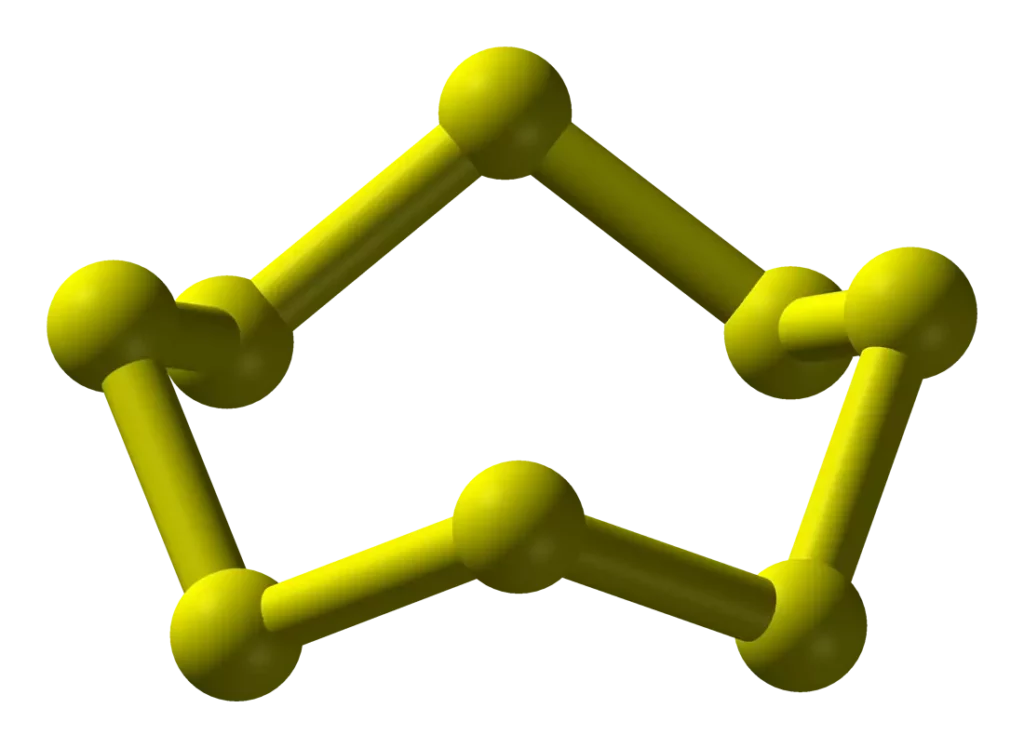
Sulphur its Compounds and Properties Sulphur (S): Sulphur is the 2nd element of the oxygen family. Sulphur forms a large number of allotropes. Among these Yellow Rhombic (α-Sulphur) and Monoclinic (β -Sulphur) forms are the most important. The stable form at room temperature is rhombic sulphur, which transforms into monoclinic sulphur when heated above 369 K.   (i) Rhombic Sulphur (a – Sulphur): This allotrope is yellow in colour, m.p. 385.8 K and specific gravity 2.06. Rhombic sulphur crystals are formed on evaporating the solution of roll sulphur in CS2. It is insoluble in water but dissolved to some extent in benzene, alcohol and ether. It is…

Read More

Group 16 Elements and Properties of Oxygen General Properties: (i) Ionisation Enthalpy: Ionisation enthalpy of these elements decreases down the group. It is due to an increase in size. However, the elements of this group have lower ionisation enthalpy values compared to those of Group 15 elements. This is due to the fact that Group 15 elements have extra stable half-filled p orbitals electronic configuration. The oxygen atom has less negative electron gain enthalpy than sulphur because of the compact nature of its shells due to which the electronic repulsion is greater. (ii) Oxidation State: They show -2, +2, +4, +6 oxidation…

Read More

Passage Based Questions Chemistry Class XI 1. Read the passage and answer the questions that follow: The attractive force which holds the two atoms together is called a chemical bond. A covalent bond is formed by an equal sharing of electrons. A coordinate bond is formed by unequal sharing of electrons. An ionic bond is formed by the transfer of electrons from one atom to another. Octet rule, although very useful but is not universally applicable. According to valence bond theory, a covalent bond is formed by overlapping of half-filled atomic orbitals resulting in a lowering of energy and…

Read More

Fully Solved Paper Chemistry Class XII CLASS – XII SUBJECTS – CHEMISTRY M.M.70                                                                                            TIME: 3 HOURS General Instructions: There are 33 questions in this question paper. All questions are compulsory. Section A: Q No. 1 to 16 are objective-type questions. Q.No. 1 & 2 are passage-based questions carrying 4 marks each while Q.No 3…

Read More

Organic Chemistry Distinguish Tests Distinguish between 1. (C2H5)2​NH and (CH3)3​NH i). Add HNO2​. (C2H5)2​NH will form a yellow oily compound, whereas (CH3)3​NH will form salt soluble in water. (C2H5)2​NH​ + HNO2 ​ → (C2​H5​)2​N−N=O diethylamine                N − nitrosodiethylamine​ (Yellow oily liquid)​ ii). Alternatively, add Hinsberg’s reagent (C2H5)2​NH will form compounds soluble in KOH, whereas (CH3)3​NH will not react. 2. C6H5NH2 and C6H5-NH-CH3 i). C6H5NH2 Will give Carbylamine test (primary amine) – in addition with chloroform and KOH, C6H5NH2will give offensive smelling compound. 3. To distinguish Primary, secondary and tertiary amine: i). Hinsberg test: ii). Nitrous acid test: 4. Aniline and…

Read More

Organic Chemistry Find the Compound Type Questions Que 1. An organic compound (A) (C8H16O2) was hydrolysed with dilute sulphuric acid to give carboxylic acid (B) and alcohol (C). Oxidation of (C) with chromic acid produced (B). (C) on dehydration gives but-1-ene. Identity A,B,C. Ans 1. Organic compound A is an ester as on acid hydrolysis it gives a mixture of an acid and an alcohol. Oxidation of alcohol (C) gives acid (B). Hence, the number of carbon atoms in (B) and (C) are the same. Ester (compound A) has eight C atoms. Hence, both carboxylic acid B and alcohol…

Read More

Case-Based Questions Chemistry Solid State                                 Passage – 1 Read the given passage and answer the questions that follow: A lattice can be generated by repeating a small portion called the unit cell. A crystal structure is made of atoms. In other words, the structure is an ordered array of atoms, ions or molecules. The different type of unit cells are Primitive Cubic Unit Cell, Body-centered Cubic Unit Cell, Face centered cubic unit cell. The primitive cubic unit cell has atoms only at its corner. Each atom…

Read More

Compounds and Properties of Nitrogen Dinitrogen Preparation of Dinitrogen: Dinitrogen is produced commercially by the liquefaction and fractional distillation of air. In the laboratory, dinitrogen is prepared by treating an aqueous solution of ammonium chloride with sodium nitrite. NH4CI(aq) + NaNO2(aq) → N2(g) + 2H2O(l) + NaCl (aq) It can also be obtained by the thermal decomposition of ammonium dichromate                                              (NH4)2Cr2O7  →Heat N2 + 4H2O + Cr2O3                                 …

Read More

Organic All Important Naming Reactions: Haloalkanes and Haloarenes 1) Finkelstein Reaction: This reaction used for the preparation of iodoalkanes from the corresponding chloroalkanes or bromoalkanes. 2) Fittig Reaction: In the reaction, haloarene is reacted with metallic sodium in the presence of anhydrous ether to form Diphenyl which is an aromatic hydrocarbon.                                                                                               …

Read More