Aldehyde Ketone and Carboxylic Acid Aldehyde Ketone and Carboxylic Acid Que 1. The IUPAC name of the compound having the molecular formula Cl3C – CH2CHO is (a) 3, 3, 3- trichloropropanal (b) 1, 1, 1- trichloropropanal (c) 2, 2, 2- trichloropropanal (d) Chloral Ans 1. (a) 3, 3, 3- trichloropropanal Que 2. The IUPAC name of CH3COCH(CH3)2 is (a) 2-methyl-3-butanone (b) 4-methylisopropyl ketone (c) 3-methyl-2-butanone (d) Isopropylmethyl ketone Ans 2. (c) 3-methyl-2-butanone Que 3. Identify compound X in the following sequence of reactions: Ans 3. (c) Reason: The following reaction takes place Que 4. In the following reaction, product P…
Author: Dr. Vikas Jasrotia
Electrochemistry Quiz Class 12 Chemistry The quiz Electrochemistry Quiz Class 12 Chemistry covers the whole chapter. The questions asked are important for both board examinations and various competitive examinations such as NEET, JEE, etc. Students will get exact marks along with the answers after the completion of the quiz. Electrochemistry is the study of the production of electricity from the energy released during the spontaneous chemical reaction and the use of electrical energy to bring about non-spontaneous chemical transformations. The cells used for this purpose are Electrochemical Cells and electrolytic cells. Electrochemical Cell: A cell that converts the chemical energy…
Multiple Choice Questions Redox Reaction Class 11 Multiple Choice Questions Redox Reaction Class 11 Que 1. Among NH3, HNO3, NaN3 and Mg3N2 the number of molecules having nitrogen in negative oxidation state is (a) 1 (b) 2 (c) 3 (d) 4 Ans 1. (c) Calculating the oxidation state of nitrogen in given molecules Oxidation state of N in NH3 is x + 3 × (+ 1) = 0 or x = – 3 Oxidation state on N in NaNO3 is 1 + x + 3 × (– 2) = 0 or x = + 5 Oxidation state…
Difference Between Atom and Element Difference Between Atom and Element When you are studying chemistry, terms like pure substance, elements, compounds, and atoms are the most commonly used terms amongst others. We all know that a substance is made up of elements and atoms. Atoms and elements are well known to almost all around. But did you ever think about the difference between the two? Let’s find the difference between the two. The main difference is elements are made of atoms. Other differences are given below: S. No. Element Atom 1. An element is a primary form of a substance…
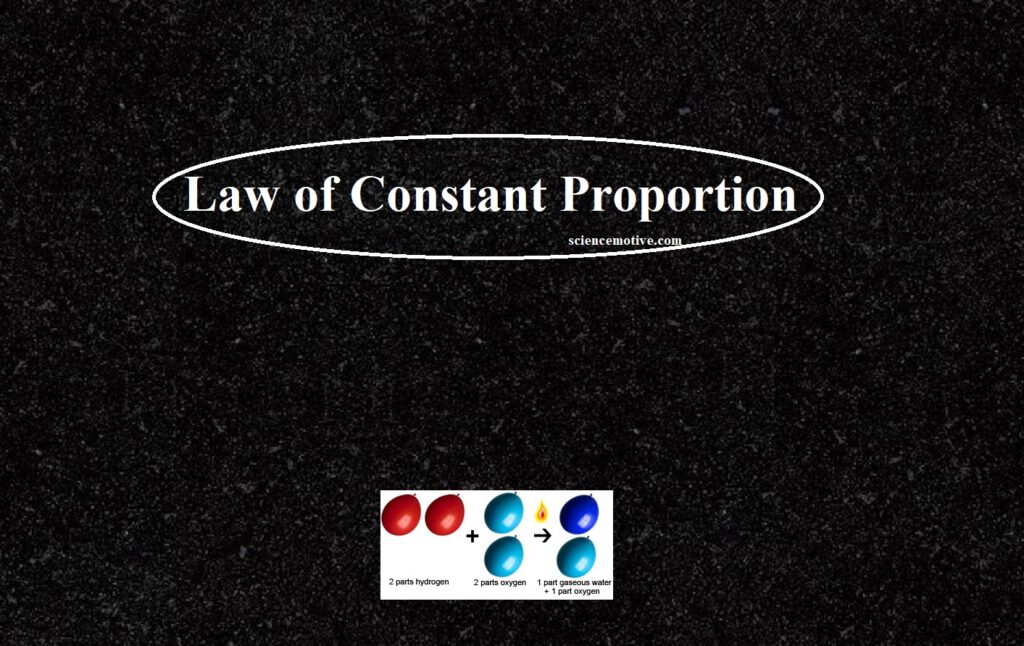
Law of Constant Proportion Law of Constant Proportion The combination of elements to form compounds is governed by the following five basic laws: Law of Conservation of Mass Law of Constant Proportion Law of Multiple Proportions Gay Lussac’s Law of Gaseous Volumes Avogadro’s Law In Chemistry, the Law of Definite Proportion is sometimes called Proust’s law or the law of constant composition. According to this law, a chemical compound always contains the same elements combine together in a fixed ratio by mass. This implies that any pure sample of a compound, no matter the source, will always consist of the same elements…
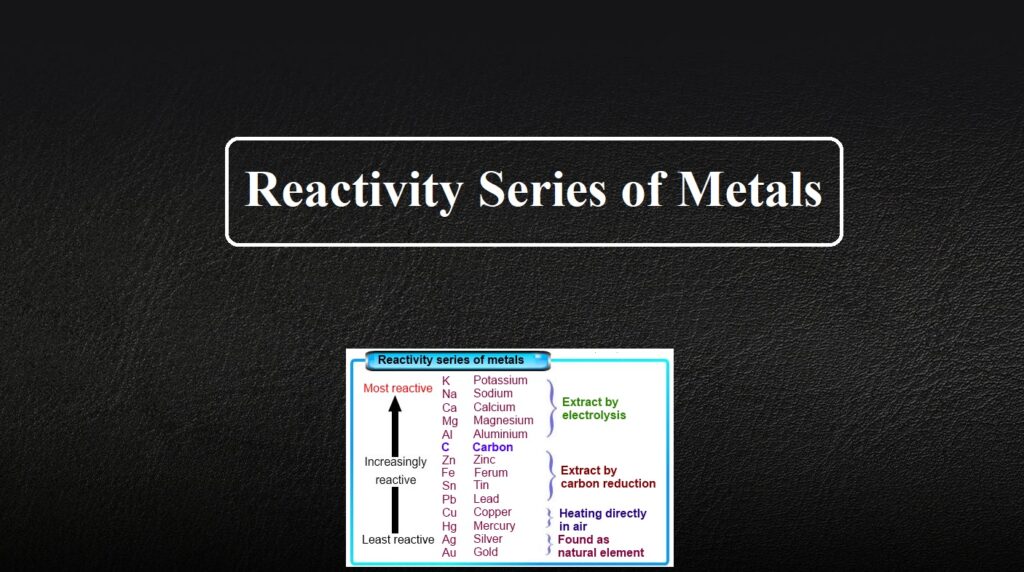
Reactivity Series of Metals Reactivity Series of Metals The metal reactivity series is a very important concept in chemistry, placing the metals, in order of reactivity from most reactive to least reactive. It’s also a useful method in predicting the products of simple displacement reactions involving two different metals, as well as it also provides an insight into why different metals are extracted from their ores in different manners. The reactivity of metals is because of their incomplete outer orbitals or due to their electronic configuration. Metals form positively charged ions as they tend to lose electrons. Metals with high…
Thermodynamics Class 11 Chemistry Thermodynamics Class 11 Chemistry Thermodynamics (Greek word thermo means heat and dynamics means motion) is the branch of science which deals with the study of different forms of energy and the quantitative relationships between them. The study of thermodynamics is purely based upon three generalizations these are first, the second, and third law of thermodynamics. Some important definitions involved: System: A system is the part of the universe that is under observation or investigation. Surroundings: The part of the universe except the system is called surroundings. The system and surroundings are separated by a boundary…
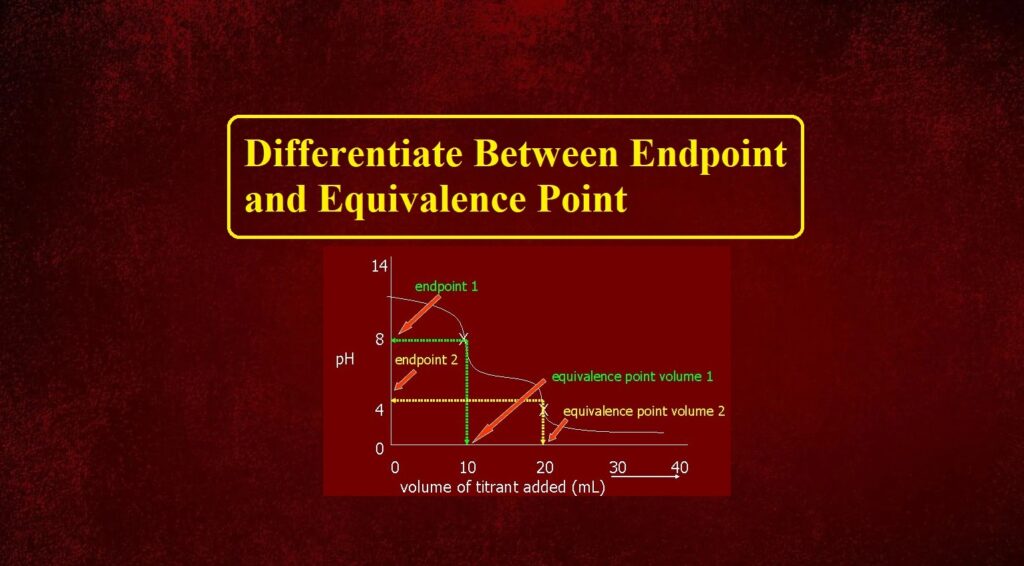
Endpoint and Equivalence Point Endpoint and Equivalence Point Titration is a common laboratory method or process of determining the concentration of unknown solutions by using solutions of known concentration. Solution of known concentration is known as Titrant while the solution of unknown concentration is known as Analyte in titration technique. It is also known as titrimetric and volumetric analysis. The process is usually carried out by gradually adding a standard solution (i.e., a solution of known concentration) of titrating reagent, or titrant, from a burette, essentially a long graduated measuring tube with a stopcock and a delivery tube at its lower end.…
ASSIGNMENT ON REDOX REACTION (UNSOLVED) SOLUTIONS OF ASSIGNMENT ON REDOX REACTION (UNSOLVED) SOLUTIONS OF ASSIGNMENT ON REDOX REACTION (UNSOLVED) Ans 1. (d) Oxidation of Cu atoms. Reason: When copper turnings are added to silver nitrate solution, the solution becomes brown in color after some time because copper is more reactive than silver so it displaces silver from silver nitrate solution and forms copper nitrate solution. Ans 2. (a) Increase in oxidation number Reason: We know oxidation involves Addition of O2 or electronegative element, Removal of H/electropositive element, Loss of electrons, Increase in oxidation number. Ans 3. (d) KMnO4. Reason: The…
London Dispersion Forces Examples London Dispersion Forces Examples Intermolecular forces are the forces of attraction and repulsion between interacting particles (atoms and molecules). Attractive intermolecular forces are known as van der Waals forces. These forces include dispersion forces or London forces, dipole-dipole forces, and dipole-induced dipole forces. A particularly strong type of dipole-dipole interaction is hydrogen bonding. In the year 1930, a scientist Fritz London once explained that noble gas atoms have the ability to attract another atom by some forces such forces named as London forces. The London dispersion force is the weakest temporary attractive intermolecular force. London dispersion forces can…