Chemical Reactions And Equations Class 10 Notes Chemical Reactions And Equations Class 10 Notes Physical Change Change in physical properties. Melting Boiling Condensation Note- No change occurs in the identity of the substance Chemical Change Atoms in the reactants are rearranged to form one or more different substances. Old bonds are broken, new bonds are formed. Reactants lose their properties to form products of different properties. Examples – Cooking of food Rusting of iron Heating of Lead nitrate Souring of milk Ripening of fruit. Rusting of iron is a chemical change because A new substance iron oxide is formed. The change is permanent; the article has got a rust layer (which may…
Author: Dr. Vikas Jasrotia
States of Matter Class 11 Important Questions Chemistry Chapter – 5 Class 11 Important Questions Chemistry Que 1. What is Absolute Temperature? Ans 1. It is also called thermodynamic temperature (or) kelvin temperature. It is a temperature on the absolute (or) Kelvin scale in which zero at -273.16 0C. ∴ T= (t0C + 273.16 K) Que 2. What is Absolute Zero? Ans 2. It is the lowest temperature theoretically possible at which the volume of a perfect gas is zero. Que 3. Why Helium is used in balloons in place of hydrogen? Ans 3. Helium is used in balloons in place of hydrogen…
Que. According to the adsorption theory of catalysis, why the speed of the reaction increases? Ans. According to the adsorption theory of catalysis, the activity of catalysis is due to the presence of free valences on its surface due to which surface of catalyst has the chemical force of attraction. When the gas comes in contact with this surface molecules get attached through these valences. Further, the rate of reaction is always increased by decreases in activation energy. When any of the reactants is strongly adsorbed on the surface of the catalyst, the rate becomes inversely proportional to the concentration…
The Volume of a Gas Decreases From Que. The volume of a gas decreases from 500 cc to 300 cc when a sample of gas is compressed by an average pressure of 0.6 atm. During this process, 10 J of heat is liberated. Find the change in internal energy Ans: We know ΔE = q + W Change in Volume (V) = 500 – 300 = 200 cc = 0.2 litre, Pressure (P) = 0.6 atm and heat liberated (q) = 10 J Work done (W) = PΔV = (0.2 × 0.6) = 0.12 litre – atm But 1 litre…
Assertion Reasoning Type Questions: Chemical Kinetics Assertion Reasoning Type Questions Read the statements given as assertion & reason both and choose the correct option as per the following instructions. (A) if both assertion & reason are correct statements and reason is the correct explanation of assertion. (B) if both assertion & reason are correct statements and reason is not the correct explanation of assertion. (C) if the assertion is the correct statement & the reason is an incorrect statement. (D) if the assertion is incorrect statement and reason is the correct statement. 1. Assertion: The order of reaction can be…
Electrolysis and Faraday’s Laws of Electrolysis Electrolysis and Faraday’s Laws The process of decomposition of an electrolyte on passing an electric current through its aqueous solution or in the fused state is called electrolysis. An electrolyte (AB) when dissolved in water or when melted dissociates to produce corresponding ions (e.g., A+ and B–). When the circuit is completed by closing the key, the following reactions occur at the two electrodes. (a) The cations move towards the cathode. On reaching the cathode, they gain electrons (supplied by the battery) and thus become neutral atoms (At cathode) A+ + e– —> A (Reduction) (b) …
CBSE Class 12 Important Questions Chapter Surface Chemistry CBSE Class 12 Important Questions 1. What is Kraft temperature? Ans 1. The specific temperature at which micelles formation takes place is called Kraft temperature. 2. Explain important characteristics of enzyme catalysis. Ans 2. Important characteristics of enzyme catalysis are (i) Highly specific in nature. (ii) Highly active under optimum temperature. (iii) In presence of co-enzymes activity gets increased. (iv) Being colloidal in nature, efficiencies decrease in presence of electrolytes. (v) Favourable range of pH is 5 to 7. 3. Explain critical micelles concentration. Ans 3. The particular concentration above which true…
Surface Chemistry Class 12 Important Questions Surface Chemistry Class 12 Important Questions Que 1. What do you mean by the term –Adsorption? Ans 1. The accumulation of molecular species at the surface rather than in the bulk of a solid-liquid is termed Adsorption. Que 2. Why does the solution of organic dye turn colourless when charcoal is added? Ans 2. Because the molecules of the dye accumulate on the surface of charcoal and turn into the solution colourless. Que 3. Explain the modern theory of heterogeneous catalysis. Ans 3. According to the modern theory of catalysis, the mechanism of heterogeneous…
CBSE Class 12 Chemistry Syllabus 2021-22 (Term 2) This post is about CBSE Class 12 Chemistry Syllabus 2021-22 for term 2. The syllabus along with deleted portion is also mentioned in this post Units Deleted Topics Unit 1 – Electrochemistry: Redox Reactions, Emf of A Cell, Standard Electrode Potential, Nernst Equation And Its Application To Chemical Cells, Relation Between Gibbs Energy Change And Emf Of A Cell, Conductance In Electrolytic Solutions, Specific And Molar Conductivity, Variations Of Conductivity With Concentration, Kohlrausch’s Law, Electrolysis And Law of Electrolysis (Elementary Idea), Dry Cell-Electrolytic Cells And Galvanic Cells, Lead Accumulator, Fuel Cells,…
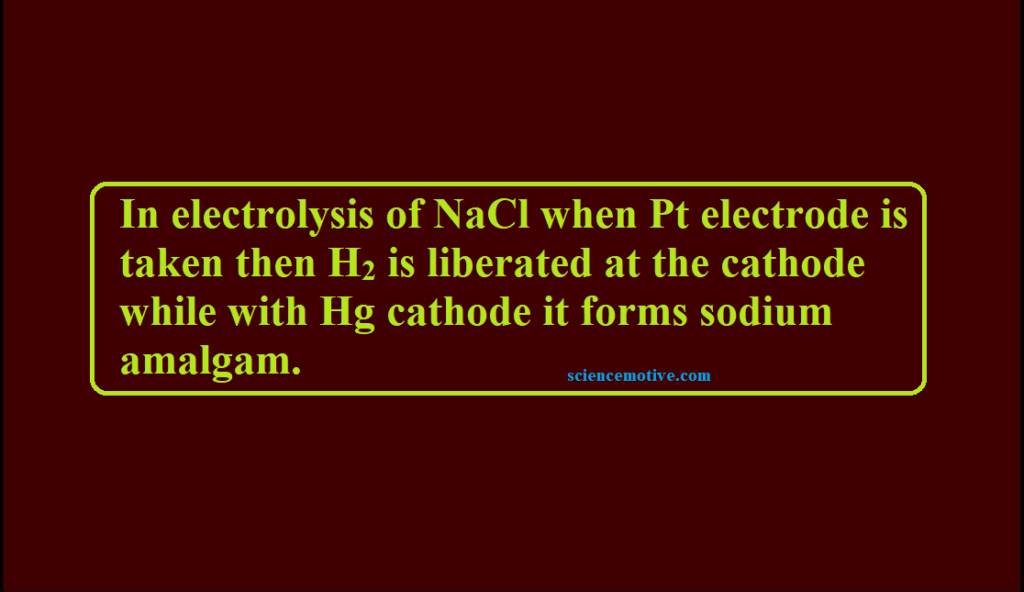
Electrolysis of NaCl When Pt Electrode Que. In electrolysis of NaCl when Pt electrode is taken then H2 is liberated at the cathode while with Hg cathode it forms sodium amalgam. The reason for this is (a) Hg is more inert than Pt (b) more voltage is required to reduce H+ at Hg than at Pt (c) Na is dissolved in Hg while it does not dissolve in Pt (d) conc. of H+ ions is larger when Pt electrode is taken. Ans. (b) When sodium chloride is dissolved in water, it ionizes as NaCl Na+ + Cl–. Water also dissociates…