Close Menu
    Facebook X (Twitter) Instagram
    ScienceMotive
    • Class 9
      • Matter in Our Surroundings
      • Is Matter Around Us Pure
      • Atoms and Molecules
      • Structure of the Atom
      • The Fundamental Unit of Life
    • Class 10
      • Chapter 1: Chemical Reactions and Equations
      • Chapter 2: Acids, Bases & Salts
      • Chapter 3: Metals & Non-Metals
      • Chapter 4: Carbon and its Compounds
      • Chapter 5: Periodic Classification of Elements
      • Chapter 6: Life Processes
      • Chapter 7: Control and Coordination
      • Chapter 8: How Do Organisms Reproduce?
      • Chapter 9: Heredity and Evolution
      • Chapter 10: Light – Reflection and Refraction
      • Chapter 11: Human Eye and the Colourful World
      • Chapter 12: Electricity
      • Chapter 13: Magnetic Effects of Electric Current
      • Chapter 14: Sources of Energy
      • Chapter 15: Our Environment
      • Chapter 16: Management of Natural Resources
    • Class 11
      • Chemisrty 11
        • Chapter – 1 Some Basic Concepts of Chemistry
        • Chapter – 2 Structure Of Atom
        • Chapter – 3 Classification of Elements and Periodicity in Properties
        • Chapter – 4 Chemical Bonding and Molecular Structure
        • Chapter – 5 States of Matter
        • Chapter – 6 Thermodynamics
        • Chapter – 7 Equilibrium
        • Chapter – 8 Redox Reaction
        • Chapter – 10 s-Block Elements
        • Chapter – 13 Hydrocarbons
    • Class 12
      • Chemistry 12
        • The Solid State
        • Solutions
        • Electrochemistry
        • Chemical Kinetics
        • Surface Chemistry
        • p – Block Elements
        • d & f Block Elements
        • Coordination Compounds
        • Haloalkanes and Haloarenes
        • Alcohols, Phenols and Ethers
        • Aldehydes, Ketones and Carboxylic Acids
        • Amines
        • Biomolecules
        • Polymers
        • Chemistry in Everyday Life
    • Practice Questions
      • +1
      • +2
    • Test Series
      • Class 9 Test Series
      • Class 10 Test Series
      • Class 11 Test Series
      • Class 12 Test Series
    • World
      • Current Affairs
      • General Knowledge
    ScienceMotive
    Home » A compound made up of two elements A and B has A= 70 %, B = 30 %

    A compound made up of two elements A and B has A= 70 %, B = 30 %

    Dr. Vikas JasrotiaBy Dr. Vikas JasrotiaSeptember 21, 2022Updated:September 22, 2022No Comments
    Share
    Facebook WhatsApp Telegram Twitter Email

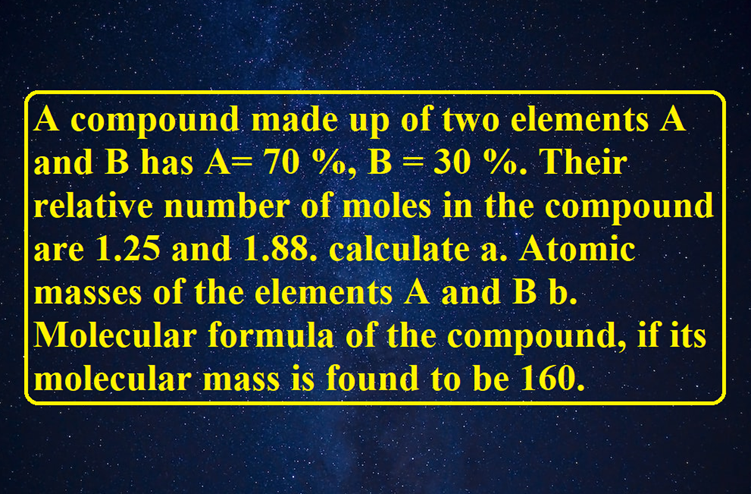
    Que: A compound made up of two elements A and B has A= 70 %, B = 30 %. Their relative number of moles in the compound are 1.25 and 1.88. calculate a. Atomic masses of the elements A and B b. Molecular formula of the compound, if its molecular mass is found to be 160.

    Ans. Relative no. of moles of an element = % of the element/Atomic mass
    Atomic mass = % of the element/Relative no. of moles = 70/1.25 = 56
    Atomic mass of B = 30/1.88 = 16
    Calculation of Empirical formula

    Element Relative no. of moles Simplest molar ratio Simplest whole no. molar ratio
    A 1.25 1.25/1.25 = 1 2
    B 1.88 1.88/1.25 = 1.5 3

    Empirical formula = A2B3
    Calculation of molecular formula
    Empirical formula mass = 2 x 56 + 3 x 16 = 160
    n = molecular mass / Empirical formula mass = 160/160 = 1
    Molecular formula = A2B3
     

    Advertisement
    Share. Facebook Twitter Pinterest LinkedIn Tumblr Email
    Dr. Vikas Jasrotia
    • Website

    Related Posts

    Thermodynamics PDF

    June 3, 2024

    States of Matter Class 11 Notes PDF

    May 30, 2024

    Question 2.12: Electrons are emitted with zero velocity from a metal surface when it is exposed to radiation of wavelength 6800 Å. Calculate the threshold frequency (ν0) and work function (W0) of the metal.

    September 29, 2023
    Leave A Reply Cancel Reply

    READ ALSO

    Organic Explanations

    September 8, 2025

    Thermodynamics PDF

    June 3, 2024

    States of Matter Class 11 Notes PDF

    May 30, 2024

    Chemistry Class 11 Chapter 2 Question Number 2.26 and 2.27

    January 11, 2024
    +2

    Organic Explanations

    By Dr. Vikas JasrotiaSeptember 8, 2025

    Organic Chemistry Important Explanations Organic Explanations S.No 1 Bond enthalpy decreases as: CH3-F > CH3-Cl…

    Class 11

    Thermodynamics PDF

    By Dr. Vikas JasrotiaJune 3, 2024

    THERMODYNAMICS PDF THERMODYNAMICS PDF Introduction Chemical thermodynamics deals with the relationship between various forms of…

    Chapter - 5 States of Matter

    States of Matter Class 11 Notes PDF

    By Dr. Vikas JasrotiaMay 30, 2024

    States of Matter Class 11 Notes PDF States of Matter Class 11 Notes PDF Gas…

    Advertisement
    Advertisement
    Facebook X (Twitter) Instagram Pinterest YouTube
    • Disclaimer
    • Contact Us
    • Privacy Policy 
    • Terms and Conditions
    © 2025 All Rights Reserved ScienceMotive.

    Type above and press Enter to search. Press Esc to cancel.