Close Menu
    Facebook X (Twitter) Instagram
    ScienceMotive
    • Class 9
      • Matter in Our Surroundings
      • Is Matter Around Us Pure
      • Atoms and Molecules
      • Structure of the Atom
      • The Fundamental Unit of Life
    • Class 10
      • Chapter 1: Chemical Reactions and Equations
      • Chapter 2: Acids, Bases & Salts
      • Chapter 3: Metals & Non-Metals
      • Chapter 4: Carbon and its Compounds
      • Chapter 5: Periodic Classification of Elements
      • Chapter 6: Life Processes
      • Chapter 7: Control and Coordination
      • Chapter 8: How Do Organisms Reproduce?
      • Chapter 9: Heredity and Evolution
      • Chapter 10: Light – Reflection and Refraction
      • Chapter 11: Human Eye and the Colourful World
      • Chapter 12: Electricity
      • Chapter 13: Magnetic Effects of Electric Current
      • Chapter 14: Sources of Energy
      • Chapter 15: Our Environment
      • Chapter 16: Management of Natural Resources
    • Class 11
      • Chemisrty 11
        • Chapter – 1 Some Basic Concepts of Chemistry
        • Chapter – 2 Structure Of Atom
        • Chapter – 3 Classification of Elements and Periodicity in Properties
        • Chapter – 4 Chemical Bonding and Molecular Structure
        • Chapter – 5 States of Matter
        • Chapter – 6 Thermodynamics
        • Chapter – 7 Equilibrium
        • Chapter – 8 Redox Reaction
        • Chapter – 10 s-Block Elements
        • Chapter – 13 Hydrocarbons
    • Class 12
      • Chemistry 12
        • The Solid State
        • Solutions
        • Electrochemistry
        • Chemical Kinetics
        • Surface Chemistry
        • p – Block Elements
        • d & f Block Elements
        • Coordination Compounds
        • Haloalkanes and Haloarenes
        • Alcohols, Phenols and Ethers
        • Aldehydes, Ketones and Carboxylic Acids
        • Amines
        • Biomolecules
        • Polymers
        • Chemistry in Everyday Life
    • Practice Questions
      • +1
      • +2
    • Test Series
      • Class 9 Test Series
      • Class 10 Test Series
      • Class 11 Test Series
      • Class 12 Test Series
    • World
      • Current Affairs
      • General Knowledge
    ScienceMotive
    Home » Solutions Chemistry Class 12 Chapter Solution Test Paper – 2

    Solutions Chemistry Class 12 Chapter Solution Test Paper – 2

    Dr. Vikas JasrotiaBy Dr. Vikas JasrotiaMay 6, 2022Updated:May 10, 2022No Comments
    Share
    Facebook WhatsApp Telegram Twitter Email

    Solutions Chemistry Class 12 Chapter Solution Test Paper – 2

    Solutions Class 12 Chapter Solution Test Paper

    Ans 1.
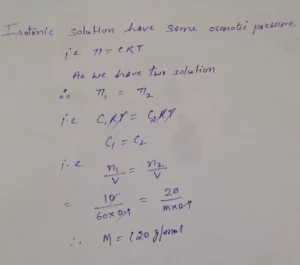
    Ans 2. The solute is 50% dissociated
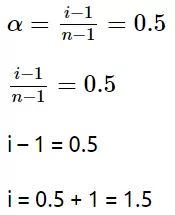
    Ans 3.
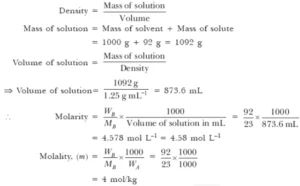
    Ans 4.
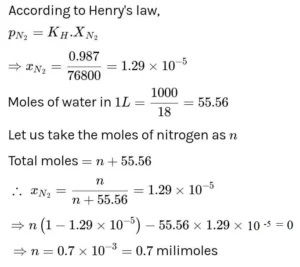
    Ans 5. According to Raoult’s law, 
    (p0 – p) / p0 = (w × M) / (m × W)
    p0 → is Vapour pressure of pure water
    p → is vapour pressure of the solvent
    w → is weight of solute
    m → is the molecular weight of solute
    W → is the molecular weight of solvent
    (32 – 31.84) / 32 = (10 × 18) / (m × 200)
    m = 180 g/mol.

    Solutions Class 12 Chapter Solution Test Paper

    Ans 6.  p0 = 0.850 bar = Vapour pressure of pure benzene.
    p = 0.845 bar = Vapour pressure of solution.
    w1 = 39 g = Mass of benzene
    w2 = 78 g = Mass of solute
    M1 = 78 g/mol = Molar mass of benzene.
    M2 = Molar mass of solute.
    (p0 – p)/p = w2 × M1 / w1 × M2
    (p0 – p) = 0.850 – 0.845 = 0.005 bar
    w2 × M1 = 0.5 × 78 = 39
    w1 × M2 = 39 × M2
    0.005 = 39/39 × M2
    0.005/0.850 = 1/M2
    M2 = 1 × 0.850 / 0.005 = 170 g/mol

    Ans 7.
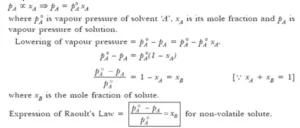
    Ans 8. Moles of glucose = 18 g/ 180 g mol–1 = 0.1 mol
    No of kg of solvent = 1 kg
    therefore, molality of glucose solution = 0.1 mol kg-1
    For water, change in boiling point
    ΔTb = Kb × m = 0.52 K kg mol–1 × 0.1 mol kg–1 = 0.052 K
    Since water boils at 373.15 K at 1.013 bar pressure.
    The boiling point of solution will be 373.15 + 0.052 = 373.202 K.

    Ans 9. 80.2 g of water contains = 0.520 g
    1000 g of water contains = 0.52 × 1000/80.2 = 6.484 g of Glucose.
    No. of moles of Glucose = 6.484/180 = 0.036
    increase in boiling point of water = Kb × m,
    where’s Kb = 0.52, m = 0.036.
    So ∆Tb = 0.52 × 0.036 = 0.0187
    So boiling point of Solution
    = 100° + 0.0187° = 100.0187°C
    = 273 + 100.0187 = 300.0187 K

    Ans 10.  Kb for benzene = 2.53 K KJ/mole
    Mass of solute = W2 = 1.8 g = 1.8 × 10⁻³ kg
    Mass of Solvent = W1 = 90g = 90 × 10-3
    Boiling point of solution = Tb = 354.11 K
    Boiling point of pure solvent = Tb’ = 353.23 K
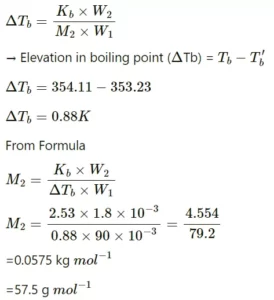
    Ans 11. Given

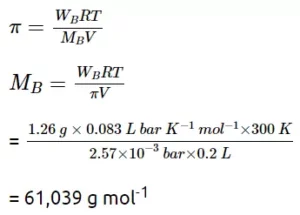
    Ans 12.  We know
    Ans 13. CCl3​COOH → CCl3​COO− + H+
    ΔTb​ = (100.18 + 273) − (100 − 273) = 0.18K
    Molality is 1.
    Hence, ΔTb​ = iKb​m = iKb ​× 1
    i = ΔTb / Kb
    i = 0.18 / 0.512
    i = 0.351

    Ans 14. We know
    ΔTf = i Kf​ m
    2.93 = 1.86 × 5.61 × i
    i = 1.86 × 5.61 / 2.93
    i = 0.28

    Ans 15. We know
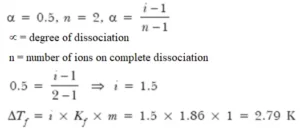
    ΔTf = i Kf​ m

    Freezing point of solution = 273 – 2.79 = 270.21 K

    Ans 16. 1 molar solution means that 1 gram mole of KCI is dissolved in one litre of the solution.
    Mass of 1L of solution = V × d = 1000 × 1.04 = 1040 g
    Mass of one mole KCI = 39 + 35.5 = 74.5 g
    Mass of solvent =1040 – 74.5 = 965.5 g = 0.965 kg
    Molality of solution (m) = No. of moles of solute / Mass of solvent in kg
    = 1/ 0.965 mol/kg = 1.0357 m
    KCl dissociates as: KCl → K+ + Cl−
    ∴ Number of particles after dissociation = 2
    ∴ van’t Hoff factor, i = 2
    Now ΔTb = i × Kb × m = 2 × 0.52 × 1.0357 = 1.078 ∘C
    ∴ Boiling point of the solution = 100 + 1.078 = 101.078 ∘C

    Ans 17. As NaCl undergoes complete dissociation
    NaCl → Na+ + Cl−
    One mole of NaCl will give 2 particle and the value of i will be equal to 2.
    ΔTf = i kf m
    Kf = 1.86 K m−1,
    ΔTf = 3K, i=2
    ∴ 3 = 2 × 1.86 × m
    ∴ m = 0.806 mol/kg
    Amount of NaCl = 0.806 × 58.5 = 47.151 = 0.806 × 58.5 = 47.151 g/kg

    Ans 18. 
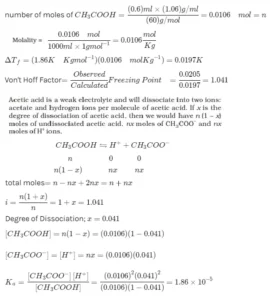
    Ans 19.
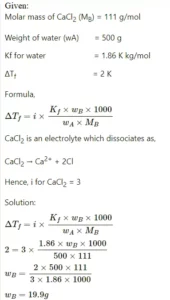
    Ans 20.
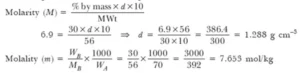
    Advertisement
    Solutions Class 12 Chapter Solution Test Paper
    Share. Facebook Twitter Pinterest LinkedIn Tumblr Email
    Dr. Vikas Jasrotia
    • Website

    Related Posts

    (Solutions) Chemical Kinetics Class 12 Test – 1

    June 14, 2022

    Chemical Kinetics Class 12 Test – 1

    June 8, 2022

    Answers Electrochemistry Important Questions – Class 12

    June 7, 2022
    Leave A Reply Cancel Reply

    READ ALSO

    Haloalkanes And Haloarenes-

    February 9, 2026

    Organic Explanations

    September 8, 2025

    Thermodynamics PDF

    June 3, 2024

    States of Matter Class 11 Notes PDF

    May 30, 2024
    +2

    Haloalkanes And Haloarenes-

    By Dr. Vikas JasrotiaFebruary 9, 2026

    Haloalkanes And Haloarenes Read the given passage and answer the questions below: Passage – 1:…

    +2

    Organic Explanations

    By Dr. Vikas JasrotiaSeptember 8, 2025

    Organic Chemistry Important Explanations Organic Explanations S.No 1 Bond enthalpy decreases as: CH3-F > CH3-Cl…

    Class 11

    Thermodynamics PDF

    By Dr. Vikas JasrotiaJune 3, 2024

    THERMODYNAMICS PDF THERMODYNAMICS PDF Introduction Chemical thermodynamics deals with the relationship between various forms of…

    Advertisement
    Advertisement
    Facebook X (Twitter) Instagram Pinterest YouTube
    • Disclaimer
    • Contact Us
    • Privacy Policy 
    • Terms and Conditions
    © 2026 All Rights Reserved ScienceMotive.

    Type above and press Enter to search. Press Esc to cancel.