Close Menu
    Facebook X (Twitter) Instagram
    ScienceMotive
    • Class 9
      • Matter in Our Surroundings
      • Is Matter Around Us Pure
      • Atoms and Molecules
      • Structure of the Atom
      • The Fundamental Unit of Life
    • Class 10
      • Chapter 1: Chemical Reactions and Equations
      • Chapter 2: Acids, Bases & Salts
      • Chapter 3: Metals & Non-Metals
      • Chapter 4: Carbon and its Compounds
      • Chapter 5: Periodic Classification of Elements
      • Chapter 6: Life Processes
      • Chapter 7: Control and Coordination
      • Chapter 8: How Do Organisms Reproduce?
      • Chapter 9: Heredity and Evolution
      • Chapter 10: Light – Reflection and Refraction
      • Chapter 11: Human Eye and the Colourful World
      • Chapter 12: Electricity
      • Chapter 13: Magnetic Effects of Electric Current
      • Chapter 14: Sources of Energy
      • Chapter 15: Our Environment
      • Chapter 16: Management of Natural Resources
    • Class 11
      • Chemisrty 11
        • Chapter – 1 Some Basic Concepts of Chemistry
        • Chapter – 2 Structure Of Atom
        • Chapter – 3 Classification of Elements and Periodicity in Properties
        • Chapter – 4 Chemical Bonding and Molecular Structure
        • Chapter – 5 States of Matter
        • Chapter – 6 Thermodynamics
        • Chapter – 7 Equilibrium
        • Chapter – 8 Redox Reaction
        • Chapter – 10 s-Block Elements
        • Chapter – 13 Hydrocarbons
    • Class 12
      • Chemistry 12
        • The Solid State
        • Solutions
        • Electrochemistry
        • Chemical Kinetics
        • Surface Chemistry
        • p – Block Elements
        • d & f Block Elements
        • Coordination Compounds
        • Haloalkanes and Haloarenes
        • Alcohols, Phenols and Ethers
        • Aldehydes, Ketones and Carboxylic Acids
        • Amines
        • Biomolecules
        • Polymers
        • Chemistry in Everyday Life
    • Practice Questions
      • +1
      • +2
    • Test Series
      • Class 9 Test Series
      • Class 10 Test Series
      • Class 11 Test Series
      • Class 12 Test Series
    • World
      • Current Affairs
      • General Knowledge
    ScienceMotive
    Home » Electromeric Effect

    Electromeric Effect

    Dr. Vikas JasrotiaBy Dr. Vikas JasrotiaJuly 22, 2021No Comments
    Share
    Facebook WhatsApp Telegram Twitter Email


    Electromeric Effect

    An Electromeric effect is a temporary effect that takes place between two atoms joined by multiple bonds for means a double or triple bond. When the charged reagents like electrophiles or nucleophiles approach them, the electrons get polarized and displaced towards one of the constituents of the atom. The electromeric effect is a reversible reaction where there is a complete transfer of a pi-electron pair due to the influence of an electrophile or a nucleophile. The effect disappears upon withdrawal of the attacking reagent.

    Electromeric Effect

    Types of Electromeric Effects
    The electromeric effect can be broken down into two types. This classification is done based on the direction in which the electron pair is transferred.
    (i) The +E effect, which is also referred to as the positive electromeric effect
    (ii) The -E effect, which is also referred to as the negative electromeric effect
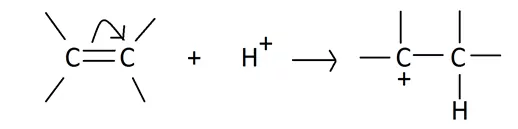
    (i) The +E effect: This effect occurs when the electron pair of the pi bond is moved towards the attacking reagent. The +E effect can be observed in the addition of acid to alkenes. 
    The +E effect is generally observed when the attacking reagent is an electrophile and the pi electrons are transferred towards the positively charged atom.
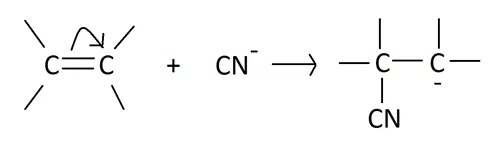
    (ii) The -E effect: This effect occurs when the electron pair of the pi bond is moved away from the attacking reagent. The -E effect is observed in the reaction of the addition of cyanide ions to carbonyl compounds. When a negatively charged reagent approaches a molecule seeking partially positive carbon, it causes an instantaneous shift of an electron pair of the C=O group towards the more electronegative oxygen atom. Hence, carbon becomes deprived of its share in this transferred pair of electrons and acquires a positive charge.
    Now let us check the characteristics of the electromeric effect from our discussion. A few of them are:
    (i) It is a temporary effect that involves a complete transfer of π-electrons to one of the bonded atoms.
    (ii) It operates in unsaturated compounds which contain at least one multiple bonds which may be polar or non-polar.
    (iii) It operates only in the presence of an attacking reagent.
    (iv) It involves a complete transfer of electrons from the reagent to the substrate and vice versa. As a result of this effect, ions are formed.

    Advertisement
    +E effect Electromeric Effect
    Share. Facebook Twitter Pinterest LinkedIn Tumblr Email
    Dr. Vikas Jasrotia
    • Website

    Related Posts

    Thermodynamics PDF

    June 3, 2024

    Question 2.12: Electrons are emitted with zero velocity from a metal surface when it is exposed to radiation of wavelength 6800 Å. Calculate the threshold frequency (ν0) and work function (W0) of the metal.

    September 29, 2023

    Question 2.11: A 25-watt bulb emits monochromatic yellow light of wavelength of 0.57µm. Calculate the rate of emission of quanta per second.

    September 27, 2023
    Leave A Reply Cancel Reply

    READ ALSO

    Organic Explanations

    September 8, 2025

    Thermodynamics PDF

    June 3, 2024

    States of Matter Class 11 Notes PDF

    May 30, 2024

    Chemistry Class 11 Chapter 2 Question Number 2.26 and 2.27

    January 11, 2024
    +2

    Organic Explanations

    By Dr. Vikas JasrotiaSeptember 8, 2025

    Organic Chemistry Important Explanations Organic Explanations S.No 1 Bond enthalpy decreases as: CH3-F > CH3-Cl…

    Class 11

    Thermodynamics PDF

    By Dr. Vikas JasrotiaJune 3, 2024

    THERMODYNAMICS PDF THERMODYNAMICS PDF Introduction Chemical thermodynamics deals with the relationship between various forms of…

    Chapter - 5 States of Matter

    States of Matter Class 11 Notes PDF

    By Dr. Vikas JasrotiaMay 30, 2024

    States of Matter Class 11 Notes PDF States of Matter Class 11 Notes PDF Gas…

    Advertisement
    Advertisement
    Facebook X (Twitter) Instagram Pinterest YouTube
    • Disclaimer
    • Contact Us
    • Privacy Policy 
    • Terms and Conditions
    © 2026 All Rights Reserved ScienceMotive.

    Type above and press Enter to search. Press Esc to cancel.