Chemical Bonding and Molecular Structure Chemical Bonding and Molecular Structure It is observed that the atoms of all the elements, except those for noble gases, tend to remain in a combined state with the atoms of the same or other elements. They do not exist as single atoms under ordinary conditions. Such atomic aggregates occur as molecules. Properties of Ionic Bond and Octet Rule: The attractive force that binds the atoms together in a molecule is called a chemical bond. It is formed either by the transfer of electrons or by the sharing of electrons. The elements with one, two,…
Author: Dr. Vikas Jasrotia
Quiz Chemical Bonding and Molecular Structure [ays_quiz id=’4′]
Chemical Bonding and Molecular Structure Questions and Answers pdf Chemical Bonding and Molecular Structure Questions and Answers pdf Multiple Choice Questions – 1 Que 1. The lattice energy of an ionic compound depends upon (a) Charge on the ion only (b) Size of the ion only (c) Packing of ions only (d) Charge on the ion and size of the ion Ans 1. (d) The value of lattice energy depends on the charges present on the two ions and the distance…
Important concepts in p- Block Elements Important concepts in p- Block Elements 1. Shielding Effect: A reduction in the effective nuclear charge on the electron cloud, due to a difference in the attraction forces on the electrons in the atom. It is a special case of electric-field screening. This effect also has some significance in many projects in material sciences. 2. Inert pair effect: The reluctance of the valence s-electrons to be available for bonding as compared to the valence p-electrons due to their greater penetration in the nucleus. 3. Fuming nitric acid: Nitric acid containing dissolved NO2…
Important Reactions of p – Block Elements Class 12 Important Reactions of p – Block Elements Class 12 Que 1. Complete the reaction: (a) XeF4 + SbF5 ⎯⎯→ (b) XeF2 + PF5 ⎯⎯→ (c) XeF4 + O2F2 ⎯⎯→ (d) Ca(OH)2 (dry) + Cl2 → (e) MnO2 + HCl → (f) 2 HNO3 → (g) 6 XeF4 + 12 H2O → (h) XeF6 + 3 H2O → Ans 1. (a) [XeF3]+ [SbF6]– (b) [XeF]+ [PF6]– (c) XeF6 + O2 (d) CaOCl2 + CaCl2 + H2O (e) MnCl2 + Cl2 + H2O (f) H2O + N2O5 (g) 4 Xe + 2 XeO3…
Practice MCQs Solid State Chemistry Class 12 Practice MCQs Solid State Chemistry Class 12 Que 1. Which of the following arrangement shows the schematic alignment of magnetic moments of antiferromagnetic substances? Que 2. Which of the following is true about the value of the refractive index of quartz glass? (a) Same in all directions (b) Different in different directions (c) Cannot be measured (d) Always zero Que 3. Which of the following statement is not true about amorphous solids? (a) On heating they may become crystalline at a certain temperature (b) They may become crystalline on keeping for…
Periodic Classification of Elements Periodic Classification of Elements Multiple Choice Questions Que 1. The valence shell electronic configuration of transition elements is (1) ns1 (2) ns2np5 (3) ns 1–2 (n – 1) d1–10 (4) ns2 (n – 1)d10 Ans 1. (3) ns 1–2 (n – 1) d1–10 Que 2. Eka-aluminium and Eka-silicon are known as (1) Gallium and Germanium (2) Aluminium and Silicon (3) Iron and Sulphur (4) Boron and Technitium Ans 2. (1) Gallium and Germanium Reason: Eka is a Sanskrit word that means one. Eka-aluminium is known as gallium and Eka-silicon is known as…
MCQs on The p-Block Elements Class 12 Chemistry MCQs on The p-Block Elements Class 12 Chemistry Que 1. Each of the following is true for white and red phosphorus except that they (a) Are both soluble in CS2 (b) Can be oxidised by heating in air (c) Consists of the same kind of atoms (d) Can be converted into one another Ans 1: (a) White phosphorus is soluble in CS2 whereas red phosphorus is insoluble in it. Que 2. Which of the following is a tetrabasic acid (a) Orthophosphorus acid (b) Orthophosphoric acid (c) Metaphosphoric acid (d) Pyrophosphoric…
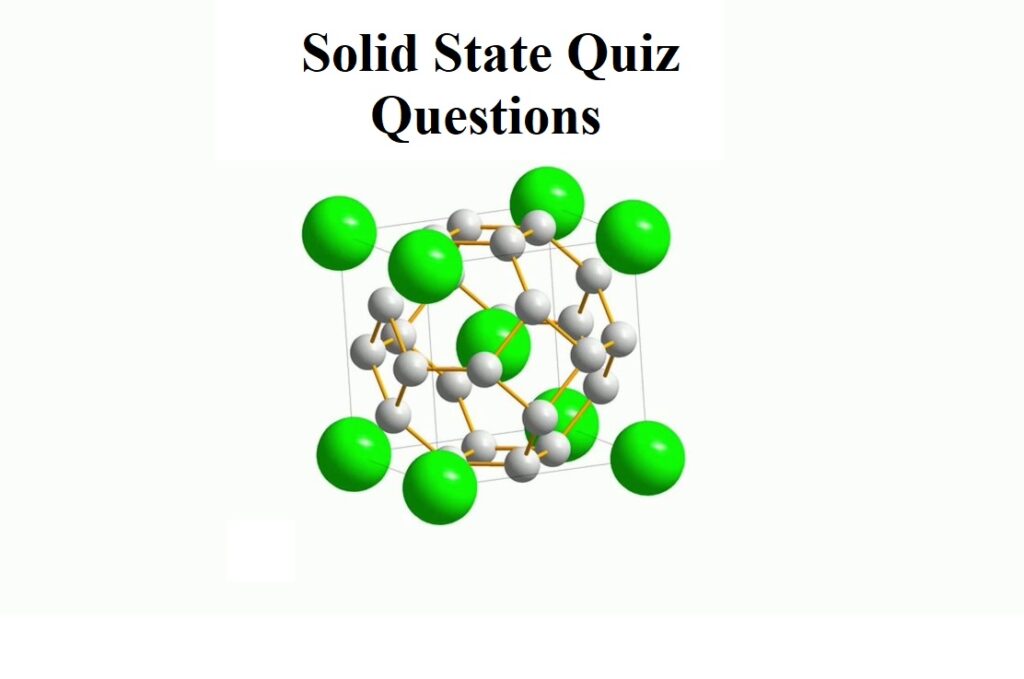
Solid State Quiz Questions Solid State Quiz Questions Solid, one of the three basic states of matter, the others being liquid and gas. (Sometimes plasmas, or ionized gases, are considered the fourth state of matter.) A solid forms from liquid or gas because the energy of atoms decreases when the atoms take up a relatively ordered, three-dimensional structure. Solids exhibit certain characteristics that distinguish them from liquids and gases. All solids have, for example, the ability to resist forces applied either perpendicular or parallel to a surface (i.e., normal or shear loads, respectively). Such properties depend on the properties of…
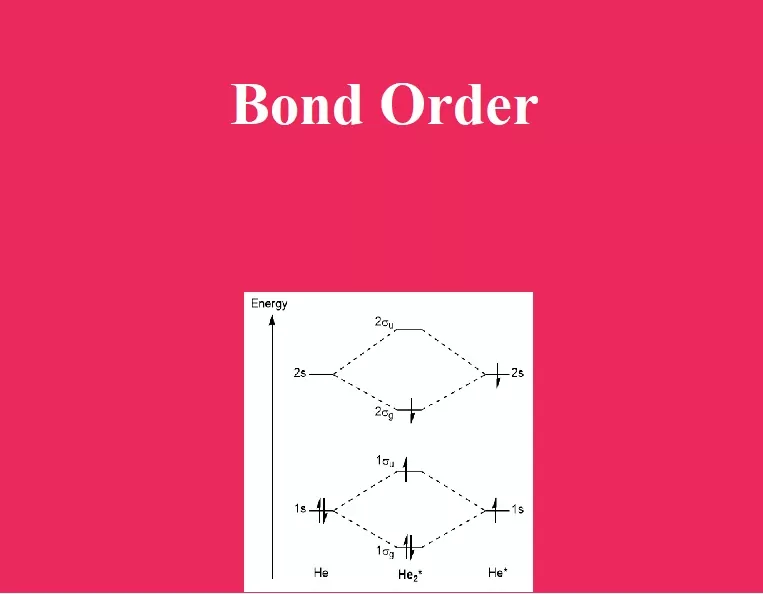
Bond Order It was introduced by Linus Pauling. Bond order is defined as half the difference between the number of bonding electrons and antibonding electrons. In a covalent bond between two atoms, a single bond has a bond order of one, a double bond has a bond order of two, a triple bond has a bond order of three, and so on. The bond number gives an indication of the stability of a bond. Isoelectronic species have the same bond number. Bond Order Formula: The Bond Order Formula can be defined as half of the difference between the number of…