Close Menu
    Facebook X (Twitter) Instagram
    ScienceMotive
    • Class 9
      • Matter in Our Surroundings
      • Is Matter Around Us Pure
      • Atoms and Molecules
      • Structure of the Atom
      • The Fundamental Unit of Life
    • Class 10
      • Chapter 1: Chemical Reactions and Equations
      • Chapter 2: Acids, Bases & Salts
      • Chapter 3: Metals & Non-Metals
      • Chapter 4: Carbon and its Compounds
      • Chapter 5: Periodic Classification of Elements
      • Chapter 6: Life Processes
      • Chapter 7: Control and Coordination
      • Chapter 8: How Do Organisms Reproduce?
      • Chapter 9: Heredity and Evolution
      • Chapter 10: Light – Reflection and Refraction
      • Chapter 11: Human Eye and the Colourful World
      • Chapter 12: Electricity
      • Chapter 13: Magnetic Effects of Electric Current
      • Chapter 14: Sources of Energy
      • Chapter 15: Our Environment
      • Chapter 16: Management of Natural Resources
    • Class 11
      • Chemisrty 11
        • Chapter – 1 Some Basic Concepts of Chemistry
        • Chapter – 2 Structure Of Atom
        • Chapter – 3 Classification of Elements and Periodicity in Properties
        • Chapter – 4 Chemical Bonding and Molecular Structure
        • Chapter – 5 States of Matter
        • Chapter – 6 Thermodynamics
        • Chapter – 7 Equilibrium
        • Chapter – 8 Redox Reaction
        • Chapter – 10 s-Block Elements
        • Chapter – 13 Hydrocarbons
    • Class 12
      • Chemistry 12
        • The Solid State
        • Solutions
        • Electrochemistry
        • Chemical Kinetics
        • Surface Chemistry
        • p – Block Elements
        • d & f Block Elements
        • Coordination Compounds
        • Haloalkanes and Haloarenes
        • Alcohols, Phenols and Ethers
        • Aldehydes, Ketones and Carboxylic Acids
        • Amines
        • Biomolecules
        • Polymers
        • Chemistry in Everyday Life
    • Practice Questions
      • +1
      • +2
    • Test Series
      • Class 9 Test Series
      • Class 10 Test Series
      • Class 11 Test Series
      • Class 12 Test Series
    • World
      • Current Affairs
      • General Knowledge
    ScienceMotive
    Home » Practice Questions Haloalkanes and Haloarenes – Class 12

    Practice Questions Haloalkanes and Haloarenes – Class 12

    Dr. Vikas JasrotiaBy Dr. Vikas JasrotiaNovember 17, 2021No Comments
    Share
    Facebook WhatsApp Telegram Twitter Email

    Practice Questions Haloalkanes and Haloarenes

    Practice Questions Haloalkanes and Haloarenes

    1. What happens when n-propyl bromide is treated with alcoholic KOH?

    2. How will you distinguish between ethyl chloride and vinyl chloride?

    3. What happens when chloroform is exposed to light and air?

    4. What happens when chloride is passed through boiling toluene in the presence of sunlight?

    5. How will you bring about the conversion: methyl bromide to methyl iodide?

    6. Write the structure and name of the compounds formed when compound ‘A’ with molecular formula is treated within the presence of FeCl3

    7. Write the chemical in which the iodide ion replaces the diazonium group in a diazonium salt.

    8. Optically active 2-iodobutane on treatment with NaI in acetone undergoes racemization. Explain.

    9. (i) Arrange alkyl halides, alkane, and water in the decreasing order of density.

    (ii) Arrange chloromethane and water in the decreasing order of density.

    10. Aryl chlorides and bromides can be easily prepared by electrophilic substitution of arenes with chloride and bromide respectively in the presence of Lewis acid catalysts but why does the preparation of iodides require the presence of an oxidizing agent.

    11. Allyl chloride is hydrolyzed more readily than n- propyl chloride. why?

    12. Why is the necessary to avoid even traces of moisture during the use of a Grignard reaction?

    13. Point out the difference between

    (i) Chirality and chiral Centre

    (ii) Enantiomers and diastereomers.

    14. Complete the following reaction by identifying (A) and (B).

    15. What happens when

    (i) Phenol reacts with methyl iodide in an alkaline medium?

    (ii) Phenol reacts with chloroform and aqueous NaOH?

    16. When t-butyl alcohol is treated with an equimolar mixture of HBr and HCl, a mixture of t-butyl bromide and t-butyl chloride is formed in which the former predominates. Explain.

    17. Why is sulphuric acid not used during the reaction of alcohols with KI?

    18. Do the following conservation

    (i) Methyl bromide to acetone

    (ii) Benzyl-chloride to 2- phenylacetic acid

    19. The treatment of alkyl chlorides with aqueous KOH leads to the formation of alcohols but in the presence of alcoholic KOH, alkanes are a major product explains.

    20. Explain the following with the help of suitable examples giving all the steps involved in the reaction. (i) Carbylamine reaction (ii) Hunsdiecker reaction.

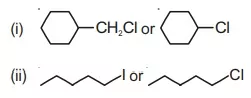
    21. Which one in the following pairs of substances undergoes SN2 substitution reaction faster and why?
    22. Complete the following reactions

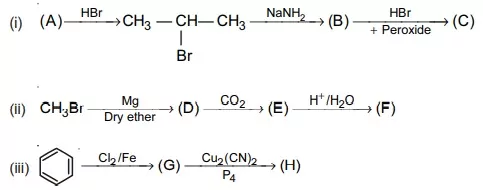
    23. Predict the compounds (A) to (H) in the following sequence of reactions:
    24. A compound (A) with molecular formula C4H10O on oxidation forms compound (B). The compound (B) gives a positive iodoform test. Compound (B) on reaction with CH3MgBr followed by hydrolysis gives (C). Identify (A) to (C) and give the sequence of reactions.

    25. Although chlorine is an electron-withdrawing group yet it is ortho-para-directing in electrophilic aromatic substitution reactions of chlorobenzene. Explain.

    Practice Questions Haloalkanes and Haloarenes

    Advertisement
    Practice Questions Haloalkanes and Haloarenes
    Share. Facebook Twitter Pinterest LinkedIn Tumblr Email
    Dr. Vikas Jasrotia
    • Website

    Related Posts

    Haloalkanes And Haloarenes-

    February 9, 2026

    Organic Explanations

    September 8, 2025

    Haloalkanes and Haloarenes Class 12 – Questions & Answers

    August 2, 2022
    Leave A Reply Cancel Reply

    READ ALSO

    Haloalkanes And Haloarenes-

    February 9, 2026

    Organic Explanations

    September 8, 2025

    Thermodynamics PDF

    June 3, 2024

    States of Matter Class 11 Notes PDF

    May 30, 2024
    +2

    Haloalkanes And Haloarenes-

    By Dr. Vikas JasrotiaFebruary 9, 2026

    Haloalkanes And Haloarenes Read the given passage and answer the questions below: Passage – 1:…

    +2

    Organic Explanations

    By Dr. Vikas JasrotiaSeptember 8, 2025

    Organic Chemistry Important Explanations Organic Explanations S.No 1 Bond enthalpy decreases as: CH3-F > CH3-Cl…

    Class 11

    Thermodynamics PDF

    By Dr. Vikas JasrotiaJune 3, 2024

    THERMODYNAMICS PDF THERMODYNAMICS PDF Introduction Chemical thermodynamics deals with the relationship between various forms of…

    Advertisement
    Advertisement
    Facebook X (Twitter) Instagram Pinterest YouTube
    • Disclaimer
    • Contact Us
    • Privacy Policy 
    • Terms and Conditions
    © 2026 All Rights Reserved ScienceMotive.

    Type above and press Enter to search. Press Esc to cancel.