Close Menu
    Facebook X (Twitter) Instagram
    ScienceMotive
    • Class 9
      • Matter in Our Surroundings
      • Is Matter Around Us Pure
      • Atoms and Molecules
      • Structure of the Atom
      • The Fundamental Unit of Life
    • Class 10
      • Chapter 1: Chemical Reactions and Equations
      • Chapter 2: Acids, Bases & Salts
      • Chapter 3: Metals & Non-Metals
      • Chapter 4: Carbon and its Compounds
      • Chapter 5: Periodic Classification of Elements
      • Chapter 6: Life Processes
      • Chapter 7: Control and Coordination
      • Chapter 8: How Do Organisms Reproduce?
      • Chapter 9: Heredity and Evolution
      • Chapter 10: Light – Reflection and Refraction
      • Chapter 11: Human Eye and the Colourful World
      • Chapter 12: Electricity
      • Chapter 13: Magnetic Effects of Electric Current
      • Chapter 14: Sources of Energy
      • Chapter 15: Our Environment
      • Chapter 16: Management of Natural Resources
    • Class 11
      • Chemisrty 11
        • Chapter – 1 Some Basic Concepts of Chemistry
        • Chapter – 2 Structure Of Atom
        • Chapter – 3 Classification of Elements and Periodicity in Properties
        • Chapter – 4 Chemical Bonding and Molecular Structure
        • Chapter – 5 States of Matter
        • Chapter – 6 Thermodynamics
        • Chapter – 7 Equilibrium
        • Chapter – 8 Redox Reaction
        • Chapter – 10 s-Block Elements
        • Chapter – 13 Hydrocarbons
    • Class 12
      • Chemistry 12
        • The Solid State
        • Solutions
        • Electrochemistry
        • Chemical Kinetics
        • Surface Chemistry
        • p – Block Elements
        • d & f Block Elements
        • Coordination Compounds
        • Haloalkanes and Haloarenes
        • Alcohols, Phenols and Ethers
        • Aldehydes, Ketones and Carboxylic Acids
        • Amines
        • Biomolecules
        • Polymers
        • Chemistry in Everyday Life
    • Practice Questions
      • +1
      • +2
    • Test Series
      • Class 9 Test Series
      • Class 10 Test Series
      • Class 11 Test Series
      • Class 12 Test Series
    • World
      • Current Affairs
      • General Knowledge
    ScienceMotive
    Home » Valence Bond Theory Coordination Compounds

    Valence Bond Theory Coordination Compounds

    Dr. Vikas JasrotiaBy Dr. Vikas JasrotiaJune 22, 2021No Comments
    Share
    Facebook WhatsApp Telegram Twitter Email

    Valence Bond Theory Coordination Compounds

    Valence Bond Theory
    The bonding in coordination compounds can be explained by Valence Bond Theory (VBT). It was developed by Pauling. This theory mainly deals with the electronic structure of central metal ion, geometry, magnetic properties of complex, kind of bonding. According to this theory, the metal atom or ion under the influence of ligands form inner orbital and outer orbital complex. These hybridized orbitals are allowed to overlap with ligand orbitals that can donate electron pairs for bonding.
    The main features of the valence bond theory are summarized below:
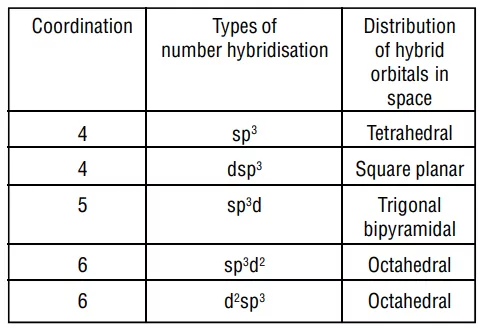
    1. Inner orbital complex: When the complex formed involved inner (n-1)d orbitals for hybridisation (d2sp3 ). Electrons are made to pair up so complex will be either diamagnetic or has fewer unpaired electrons. It is a low spin complex. Eg. [V(H2O)6]3+, [Co(NH3)6]3+.
    2. Outer orbital complex: When the complex formed uses outer d orbitals for hybridisation, (sp3d2), it has a large number of unpaired electrons. It is a high spin complex. Eg. [CoF6]3-, [Fe(H2O)6]3+.
    FORMATION OF OCTAHEDRAL COMPLEXES

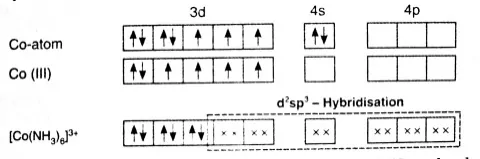
    Example: Inner orbital complex, [Co(NH3)6]3+
    Co→ [Ar]3d74s2
    Co+3→ [Ar]3d64s0
    With a +3 oxidation state NH3​ act as a strong ligand.
    All electrons are paired therefore, complex will be diamagnetic in nature.
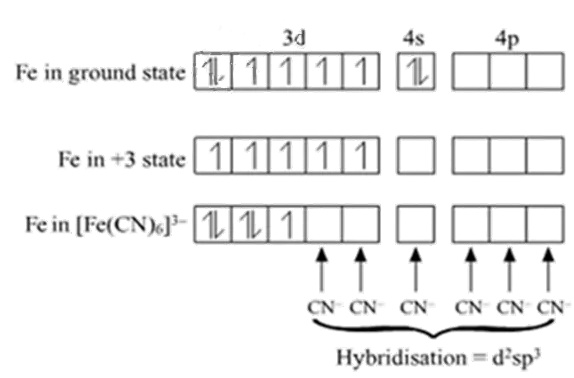
    Example: Inner orbital complex, [Fe(CN)6]3-
    Fe → [Ar]3d64s2
    Fe+3→ [Ar]3d54s0
    With +3 oxidation state CN​ act as a strong ligand.

    Valence Bond Theory Coordination Compounds

    FORMATION OF SQUARE PLANAR COMPLEXES

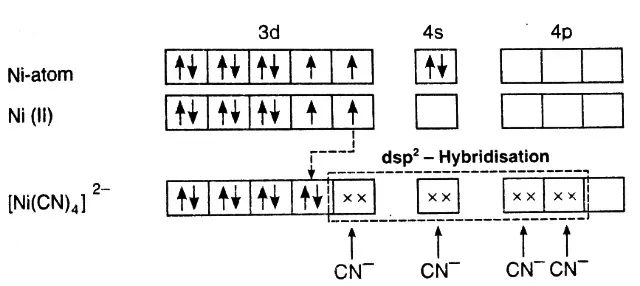
    Example: Inner orbital complex, [Ni(CN)4]2-:
    Ni – 3d8, 4s2
    Ni2+ – 3d8, 4s0
    FORMATION OF TETRAHEDRAL COMPLEXES

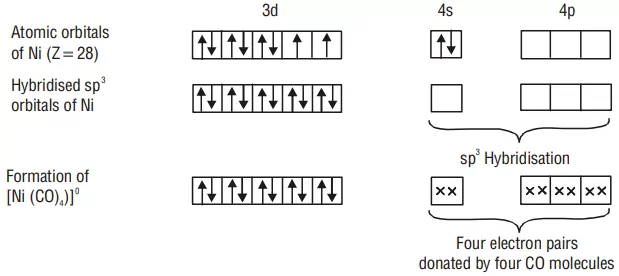
    Example: Inner orbital complex [Ni(CO)4]:
    Outer orbital complexes
    i). In these complexes s, p, and d orbitals which are involved in hybridization, belong to the highest quantum number (n).
    ii) Complex compound formed by the use of outer n and d orbitals will be paramagnetic.
    iii) Outer orbital complexes are also known as high-spin or spin-free complexes.
    iv). The outer orbital complexes have a high number of unpaired electrons, E.g. [CoF6]3–
    For Example: Outer orbital complex [CoF6]3–

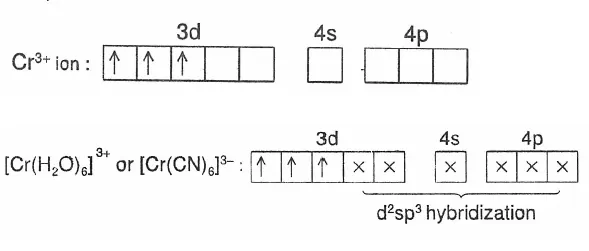
    For Example: Outer orbital complex [Cr(H2O)6]3+:
    Valence Bond Theory Coordination Compounds
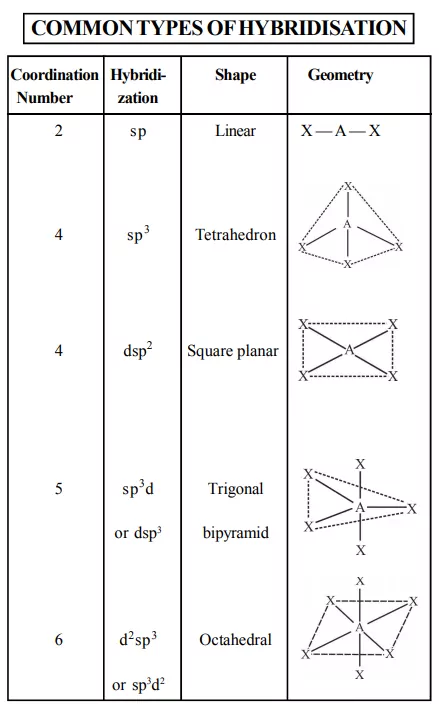
    Limitations of Valence Bond Theory:
    Even though the valence bond theory explains the formation, structures, and magnetic behavior of coordination compounds to a larger extent, it suffers from the following shortcomings:
    i). It does not explain the relative energies of different structures.
    ii). It offers no explanation of the colour observed for the complexion.
    iii). It cannot predict whether a 4-coordinate complex will be tetrahedral or square planar.
    iv). It does not take into account the splitting of d-energy levels. v. It does not explain the spectra of complexes.


    Valence Bond Theory Coordination Compounds

    Advertisement
    Coordination Compounds Inner orbital Complex Outer Orbital Complexes Valence Bond Theory
    Share. Facebook Twitter Pinterest LinkedIn Tumblr Email
    Dr. Vikas Jasrotia
    • Website

    Related Posts

    Haloalkanes And Haloarenes-

    February 9, 2026

    Organic Explanations

    September 8, 2025

    CBSE Sample Paper Session 2022-23 (Chemistry) PDF

    September 16, 2022
    Leave A Reply Cancel Reply

    READ ALSO

    Haloalkanes And Haloarenes-

    February 9, 2026

    Organic Explanations

    September 8, 2025

    Thermodynamics PDF

    June 3, 2024

    States of Matter Class 11 Notes PDF

    May 30, 2024
    +2

    Haloalkanes And Haloarenes-

    By Dr. Vikas JasrotiaFebruary 9, 2026

    Haloalkanes And Haloarenes Read the given passage and answer the questions below: Passage – 1:…

    +2

    Organic Explanations

    By Dr. Vikas JasrotiaSeptember 8, 2025

    Organic Chemistry Important Explanations Organic Explanations S.No 1 Bond enthalpy decreases as: CH3-F > CH3-Cl…

    Class 11

    Thermodynamics PDF

    By Dr. Vikas JasrotiaJune 3, 2024

    THERMODYNAMICS PDF THERMODYNAMICS PDF Introduction Chemical thermodynamics deals with the relationship between various forms of…

    Advertisement
    Advertisement
    Facebook X (Twitter) Instagram Pinterest YouTube
    • Disclaimer
    • Contact Us
    • Privacy Policy 
    • Terms and Conditions
    © 2026 All Rights Reserved ScienceMotive.

    Type above and press Enter to search. Press Esc to cancel.