Close Menu
    Facebook X (Twitter) Instagram
    ScienceMotive
    • Class 9
      • Matter in Our Surroundings
      • Is Matter Around Us Pure
      • Atoms and Molecules
      • Structure of the Atom
      • The Fundamental Unit of Life
    • Class 10
      • Chapter 1: Chemical Reactions and Equations
      • Chapter 2: Acids, Bases & Salts
      • Chapter 3: Metals & Non-Metals
      • Chapter 4: Carbon and its Compounds
      • Chapter 5: Periodic Classification of Elements
      • Chapter 6: Life Processes
      • Chapter 7: Control and Coordination
      • Chapter 8: How Do Organisms Reproduce?
      • Chapter 9: Heredity and Evolution
      • Chapter 10: Light – Reflection and Refraction
      • Chapter 11: Human Eye and the Colourful World
      • Chapter 12: Electricity
      • Chapter 13: Magnetic Effects of Electric Current
      • Chapter 14: Sources of Energy
      • Chapter 15: Our Environment
      • Chapter 16: Management of Natural Resources
    • Class 11
      • Chemisrty 11
        • Chapter – 1 Some Basic Concepts of Chemistry
        • Chapter – 2 Structure Of Atom
        • Chapter – 3 Classification of Elements and Periodicity in Properties
        • Chapter – 4 Chemical Bonding and Molecular Structure
        • Chapter – 5 States of Matter
        • Chapter – 6 Thermodynamics
        • Chapter – 7 Equilibrium
        • Chapter – 8 Redox Reaction
        • Chapter – 10 s-Block Elements
        • Chapter – 13 Hydrocarbons
    • Class 12
      • Chemistry 12
        • The Solid State
        • Solutions
        • Electrochemistry
        • Chemical Kinetics
        • Surface Chemistry
        • p – Block Elements
        • d & f Block Elements
        • Coordination Compounds
        • Haloalkanes and Haloarenes
        • Alcohols, Phenols and Ethers
        • Aldehydes, Ketones and Carboxylic Acids
        • Amines
        • Biomolecules
        • Polymers
        • Chemistry in Everyday Life
    • Practice Questions
      • +1
      • +2
    • Test Series
      • Class 9 Test Series
      • Class 10 Test Series
      • Class 11 Test Series
      • Class 12 Test Series
    • World
      • Current Affairs
      • General Knowledge
    ScienceMotive
    Home » MCQs & Assertion Reason Haloalkanes and Haloarenes

    MCQs & Assertion Reason Haloalkanes and Haloarenes

    Dr. Vikas JasrotiaBy Dr. Vikas JasrotiaOctober 10, 2020No Comments
    Share
    Facebook WhatsApp Telegram Twitter Email

    MCQs & Assertion Reason Haloalkanes and Haloarenes

    MCQs & Assertion Reason Haloalkanes and Haloarenes contain important questions of Haloalkanes and Haloarenes

    Q 1. Arrange the following compounds in increasing order of rate of reaction towards nucleophilic substitution:

    (a) a < b < c                                         (b) a < b < a
    (c) a < c < b                                         (d) c < a < b

    Q 2. Arrange the following compound in increasing order of rate of reaction towards nucleophilic substitution.

    (a) i < ii < iii                                         (b) i < iii < ii
    (c) ii < i < iii                                         (d) iii < ii < i

    Q 3. Which of the following compound will undergo racemization when the solution of KOH hydrolyses?
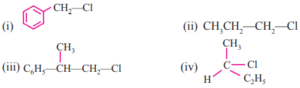
    (a) i and iv                                           (b) ii and iv
    (c) iii and iv                                         (d) iv

    Q 4. In a SN1 reaction on chiral centres, there is
    (a) 100 % retention
    (b) 100 % inversion
    (c) 100 % racemisation
    (d) inversion is more than retention leading to racemisation

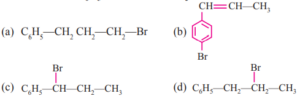
    Q 5. The reaction of C6H5—CH=CH—CH3 with HBr produces
    MCQs & Assertion Reason Haloalkanes and Haloarenes

    Q 6. In SN2 reactions, the correct order of reactivity for the following compounds:
    (i) CH3Cl
    (ii) (CH3)3CCl
    (iii) (CH3)2CHCl
    (iv) CH3CH2—Cl
    (a) i > ii > iii > iv                                 (b) iv > iii > ii > i
    (c) i > iv > iii > ii                                 (d) iv > i > ii > iii

    Q 7. Arrange the following compounds in increasing order of their boiling point:
    (i) (CH3)2CH2CH2—Br
    (ii) CH3—(CH2)—Br3
    (iii) (CH3)3C—Br
    (a) ii < i < iii                                       (b) i < ii < iii
    (c) iii < i < ii                                       (d) iii < ii < i

    Q 8. Toluene reacts with halogen in the presence of FeCl3 giving ortho and para compounds. The reactions is:
    (a) electrophilic elimination reaction                          (b) electrophilic substitution
    (c) free radical addition reaction                                (d) nucleophilic substitution

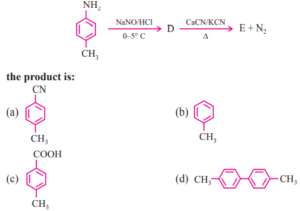
    Q 9. In the reaction
    Q10. Chlorobenzene is formed by the reaction of chlorine with benzene in presence of AlCl3. Which of the following species attacks the benzene ring in this reaction?
    (a) Cl–                                                               (b) Cl+
    (c) AlCl3                                                             (d) AlCl4 –

    MCQs & Assertion Reason Haloalkanes and Haloarenes

    Q11. The reaction of toluene with Cl2 in the presence of FeCl3 gives ‘X’ and the reaction with Cl2 in presence of light gives ‘Y’. Thus ‘X’ and ‘Y’ are:
    (a) ‘X’ = benzyl chloride and ‘Y’ = m-chlorotoluene
    (b) ‘X’ = benzyl chloride and ‘Y’ = o-chlorotoluene
    (c) ‘X’ = m-chlorotoluene and ‘Y’ = p-cholorotoluene
    (d) ‘X’ = p-chlorotoluene and ‘Y’ = benzyl chloride.

    Q12. Aryl halides are less reactive toward nucleophilic substitution reaction than alkyl halides due to
    (a) the formation of stable carbanion
    (b) resonance stabilization
    (c) longer carbon-halogen bond
    (d) sp2 hybridised carbon attached to the halogen

    Q13. A new carbon carbon bond is possible in the following reaction reactions:
    (a) C6H6 + CH3Cl3 → (anhy. AlCl3)
    (b) CH3CH2Br + CH3CH2NH2 →
    (c) CH3 —Br + CH3CH2—ONa →
    (d) CH3CH2—Br + kCN(alc) →

    Q 14. Which of the following state are correct
    (a) Benzyl halides are more reactive than vinyl and aryl halides
    (b) Vinyl/halides are more reactive than alkyl halides
    (c) Aryl halides are less reactive than alkyl halide
    (d) Aryl halides are more reactive than benzyl halides

    MCQs & Assertion Reason Haloalkanes and Haloarenes

    Note: In the following questions a statement of assertion followed by a statement of reason is given. Choose the correct answer out of the following choice.
    (a) Both assertion and reason are correct, and the reason is the correct explanation of the assertion.
    (b) Both assertion and reason are true, but the reason is not the correct explanation of the assertion.
    (c) Assertion is Incorrect, but the reason is Correct.
    (d) Both assertion and reason are Incorrect.

    Q 15. Assertion: SN2 reaction proceeds with inversion of configuration.
    Reason: SN2 reaction occurs in one step

    Q 16. Assertion: Treatment of chloroethane with a saturated solution of AgCN gives ethyl isocyanide as a major product.
    Reason: Cyanide ion (CN–) is an ambident nucleophile.

    MCQs & Assertion Reason Haloalkanes and Haloarenes

    Matching Column Type
    Q 17. Match the items of column 1 and column 2
    Column 1                                                            Column 2
    (A) CH2Cl2                                                      P. Antiseptic
    (B) CCl4                                                           Q. Insecticide
    (C) (p-ClC6H4)CHCCl3                                  R. Pyrene
    (D) CHI3                                                           S. Refrigerant
    (a) A–R, B–Q, C–S, D–P
    (b) A–S, B–R, C–Q, D–P
    (c) A–Q, B–P, C–S, D–R
    (d) A–P, B–S, C–R, D–Q

    Q18. Match the items of column 1 and column 2
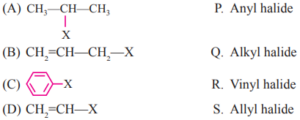
    (a) A–P, B–Q, C–S, D–P                                                  (b) A–S, B–R, C–Q, D–P
    (c) A–Q, B–P, C–S, D–R                                                  (d) A–P, B–S, C–R, D–Q

    The Answers of MCQs & Assertion Reason Haloalkanes and Haloarenes are given below:
    Q1. (c)     Q2.(a)       Q3. (d)    Q4. (d)     Q5.(c)     Q6. (c)      Q7. (c)

    Q8. (b)     Q9. (a)      Q10. (b)   Q11.(d)    Q12.(b, d) Q13.(a, d)   Q15. (a, c)

    Q 16. (b)   Q17. (b)      Q18.(b)


    MCQs & Assertion Reason Haloalkanes and Haloarenes


    Advertisement
    Assertion Reason Haloalkanes and Haloarenes Matching Type MCQs Solved
    Share. Facebook Twitter Pinterest LinkedIn Tumblr Email
    Dr. Vikas Jasrotia
    • Website

    Related Posts

    Haloalkanes And Haloarenes-

    February 9, 2026

    Organic Explanations

    September 8, 2025

    Is Matter Around Us Pure MCQ With Answers

    June 28, 2023
    Leave A Reply Cancel Reply

    READ ALSO

    Haloalkanes And Haloarenes-

    February 9, 2026

    Organic Explanations

    September 8, 2025

    Thermodynamics PDF

    June 3, 2024

    States of Matter Class 11 Notes PDF

    May 30, 2024
    +2

    Haloalkanes And Haloarenes-

    By Dr. Vikas JasrotiaFebruary 9, 2026

    Haloalkanes And Haloarenes Read the given passage and answer the questions below: Passage – 1:…

    +2

    Organic Explanations

    By Dr. Vikas JasrotiaSeptember 8, 2025

    Organic Chemistry Important Explanations Organic Explanations S.No 1 Bond enthalpy decreases as: CH3-F > CH3-Cl…

    Class 11

    Thermodynamics PDF

    By Dr. Vikas JasrotiaJune 3, 2024

    THERMODYNAMICS PDF THERMODYNAMICS PDF Introduction Chemical thermodynamics deals with the relationship between various forms of…

    Advertisement
    Advertisement
    Facebook X (Twitter) Instagram Pinterest YouTube
    • Disclaimer
    • Contact Us
    • Privacy Policy 
    • Terms and Conditions
    © 2026 All Rights Reserved ScienceMotive.

    Type above and press Enter to search. Press Esc to cancel.