Close Menu
    Facebook X (Twitter) Instagram
    ScienceMotive
    • Class 9
      • Matter in Our Surroundings
      • Is Matter Around Us Pure
      • Atoms and Molecules
      • Structure of the Atom
      • The Fundamental Unit of Life
    • Class 10
      • Chapter 1: Chemical Reactions and Equations
      • Chapter 2: Acids, Bases & Salts
      • Chapter 3: Metals & Non-Metals
      • Chapter 4: Carbon and its Compounds
      • Chapter 5: Periodic Classification of Elements
      • Chapter 6: Life Processes
      • Chapter 7: Control and Coordination
      • Chapter 8: How Do Organisms Reproduce?
      • Chapter 9: Heredity and Evolution
      • Chapter 10: Light – Reflection and Refraction
      • Chapter 11: Human Eye and the Colourful World
      • Chapter 12: Electricity
      • Chapter 13: Magnetic Effects of Electric Current
      • Chapter 14: Sources of Energy
      • Chapter 15: Our Environment
      • Chapter 16: Management of Natural Resources
    • Class 11
      • Chemisrty 11
        • Chapter – 1 Some Basic Concepts of Chemistry
        • Chapter – 2 Structure Of Atom
        • Chapter – 3 Classification of Elements and Periodicity in Properties
        • Chapter – 4 Chemical Bonding and Molecular Structure
        • Chapter – 5 States of Matter
        • Chapter – 6 Thermodynamics
        • Chapter – 7 Equilibrium
        • Chapter – 8 Redox Reaction
        • Chapter – 10 s-Block Elements
        • Chapter – 13 Hydrocarbons
    • Class 12
      • Chemistry 12
        • The Solid State
        • Solutions
        • Electrochemistry
        • Chemical Kinetics
        • Surface Chemistry
        • p – Block Elements
        • d & f Block Elements
        • Coordination Compounds
        • Haloalkanes and Haloarenes
        • Alcohols, Phenols and Ethers
        • Aldehydes, Ketones and Carboxylic Acids
        • Amines
        • Biomolecules
        • Polymers
        • Chemistry in Everyday Life
    • Practice Questions
      • +1
      • +2
    • Test Series
      • Class 9 Test Series
      • Class 10 Test Series
      • Class 11 Test Series
      • Class 12 Test Series
    • World
      • Current Affairs
      • General Knowledge
    ScienceMotive
    Home » In electrolysis of NaCl when Pt electrode is taken then H2 is liberated at the cathode while with Hg cathode it forms sodium amalgam.

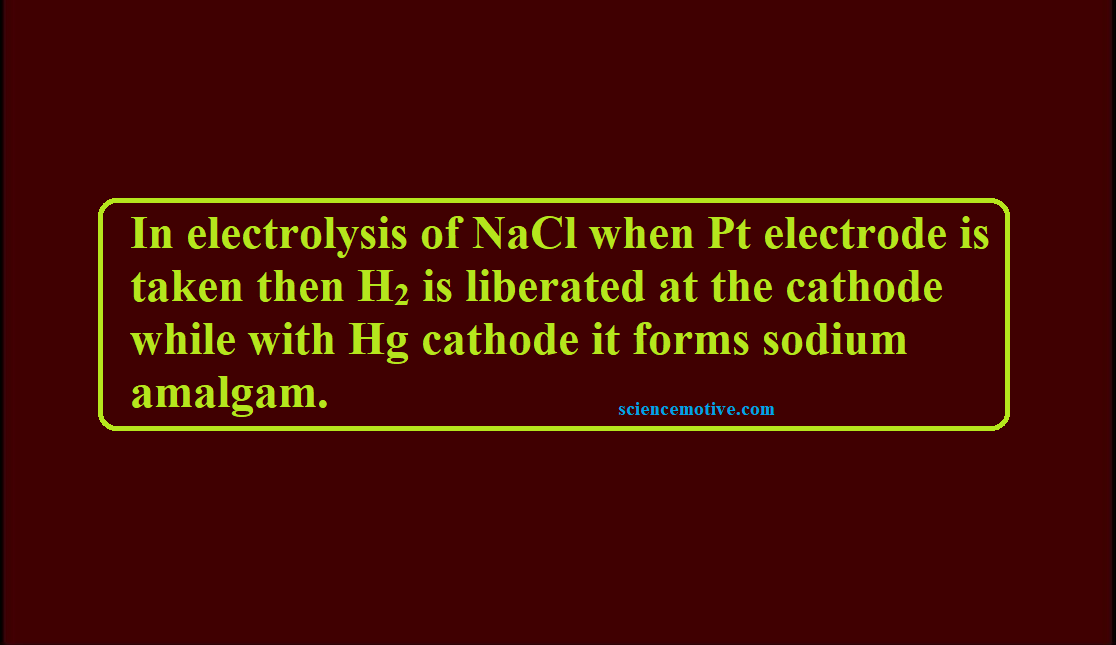
    In electrolysis of NaCl when Pt electrode is taken then H2 is liberated at the cathode while with Hg cathode it forms sodium amalgam.

    Dr. Vikas JasrotiaBy Dr. Vikas JasrotiaDecember 5, 2021No Comments
    Share
    Facebook WhatsApp Telegram Twitter Email

    Electrolysis of NaCl When Pt Electrode

    Que. In electrolysis of NaCl when Pt electrode is taken then H2 is liberated at the cathode while with Hg cathode it forms sodium amalgam. The reason for this is
    (a) Hg is more inert than Pt
    (b) more voltage is required to reduce H+ at Hg than at Pt
    (c) Na is dissolved in Hg while it does not dissolve in Pt
    (d) conc. of H+ ions is larger when Pt electrode is taken.
    Ans. (b)
    When sodium chloride is dissolved in water, it ionizes as NaCl Na+ + Cl–.
    Water also dissociates as H2O H+ + OH–
    During the passing of electric current through this solution using a platinum electrode, Na+ and H+ ions move towards the cathode. However, only H+ ions are discharged more readily than Na+ ions because of their low discharge potential (in the electromotive series hydrogen is lower than sodium). These H+ ions gain electrons and change into a neutral atom
    At cathode H+ + e– → H, H + H → H2
    Cl– and OH– ions move towards the anode. Cl– ions lose electrons and change into neutral atoms.
    At the anode, Cl– – e– → Cl, Cl + Cl → Cl2
    If mercury is used as a cathode, H+ ions are not discharged at the mercury cathode because mercury has a high hydrogen overvoltage. Na+ ions are discharged at the cathode in preference to H+ ions, yielding sodium, which dissolves in mercury to form sodium amalgam.
    At cathode: Na+ + e– → Na

    Electrolysis of NaCl When Pt Electrode

    Advertisement
    Electrolysis of NaCl When Pt Electrode
    Share. Facebook Twitter Pinterest LinkedIn Tumblr Email
    Dr. Vikas Jasrotia
    • Website

    Related Posts

    Haloalkanes And Haloarenes-

    February 9, 2026

    Organic Explanations

    September 8, 2025

    CBSE Sample Paper Session 2022-23 (Chemistry) PDF

    September 16, 2022
    Leave A Reply Cancel Reply

    READ ALSO

    Haloalkanes And Haloarenes-

    February 9, 2026

    Organic Explanations

    September 8, 2025

    Thermodynamics PDF

    June 3, 2024

    States of Matter Class 11 Notes PDF

    May 30, 2024
    +2

    Haloalkanes And Haloarenes-

    By Dr. Vikas JasrotiaFebruary 9, 2026

    Haloalkanes And Haloarenes Read the given passage and answer the questions below: Passage – 1:…

    +2

    Organic Explanations

    By Dr. Vikas JasrotiaSeptember 8, 2025

    Organic Chemistry Important Explanations Organic Explanations S.No 1 Bond enthalpy decreases as: CH3-F > CH3-Cl…

    Class 11

    Thermodynamics PDF

    By Dr. Vikas JasrotiaJune 3, 2024

    THERMODYNAMICS PDF THERMODYNAMICS PDF Introduction Chemical thermodynamics deals with the relationship between various forms of…

    Advertisement
    Advertisement
    Facebook X (Twitter) Instagram Pinterest YouTube
    • Disclaimer
    • Contact Us
    • Privacy Policy 
    • Terms and Conditions
    © 2026 All Rights Reserved ScienceMotive.

    Type above and press Enter to search. Press Esc to cancel.