Close Menu
    Facebook X (Twitter) Instagram
    ScienceMotive
    • Class 9
      • Matter in Our Surroundings
      • Is Matter Around Us Pure
      • Atoms and Molecules
      • Structure of the Atom
      • The Fundamental Unit of Life
    • Class 10
      • Chapter 1: Chemical Reactions and Equations
      • Chapter 2: Acids, Bases & Salts
      • Chapter 3: Metals & Non-Metals
      • Chapter 4: Carbon and its Compounds
      • Chapter 5: Periodic Classification of Elements
      • Chapter 6: Life Processes
      • Chapter 7: Control and Coordination
      • Chapter 8: How Do Organisms Reproduce?
      • Chapter 9: Heredity and Evolution
      • Chapter 10: Light – Reflection and Refraction
      • Chapter 11: Human Eye and the Colourful World
      • Chapter 12: Electricity
      • Chapter 13: Magnetic Effects of Electric Current
      • Chapter 14: Sources of Energy
      • Chapter 15: Our Environment
      • Chapter 16: Management of Natural Resources
    • Class 11
      • Chemisrty 11
        • Chapter – 1 Some Basic Concepts of Chemistry
        • Chapter – 2 Structure Of Atom
        • Chapter – 3 Classification of Elements and Periodicity in Properties
        • Chapter – 4 Chemical Bonding and Molecular Structure
        • Chapter – 5 States of Matter
        • Chapter – 6 Thermodynamics
        • Chapter – 7 Equilibrium
        • Chapter – 8 Redox Reaction
        • Chapter – 10 s-Block Elements
        • Chapter – 13 Hydrocarbons
    • Class 12
      • Chemistry 12
        • The Solid State
        • Solutions
        • Electrochemistry
        • Chemical Kinetics
        • Surface Chemistry
        • p – Block Elements
        • d & f Block Elements
        • Coordination Compounds
        • Haloalkanes and Haloarenes
        • Alcohols, Phenols and Ethers
        • Aldehydes, Ketones and Carboxylic Acids
        • Amines
        • Biomolecules
        • Polymers
        • Chemistry in Everyday Life
    • Practice Questions
      • +1
      • +2
    • Test Series
      • Class 9 Test Series
      • Class 10 Test Series
      • Class 11 Test Series
      • Class 12 Test Series
    • World
      • Current Affairs
      • General Knowledge
    ScienceMotive
    Home » p-Block Elements Assertion Reason Questions

    p-Block Elements Assertion Reason Questions

    Dr. Vikas JasrotiaBy Dr. Vikas JasrotiaNovember 7, 2021No Comments
    Share
    Facebook WhatsApp Telegram Twitter Email

    p-Block Elements Assertion Reason Questions

    p-Block Elements Assertion Reason Questions

    Q 1. Assertion: Hydrolysis of XeF6 is an example of a redox reaction.
    Reason: XeF6 when hydrolysed yields XeOF4 and XeO2F2
    Ans 1. (d) Assertion is wrong but the reason is the correct statement

    Q 2. Assertion: The O-O bond length in ozone is identical to that in molecular oxygen.
    Reason: The ozone molecule is a resonance hybrid of two canonical structures.
    Ans 2. (a) Both A and R are true but R is the correct explanation of A

    Q 3. Assertion: HI cannot be prepared by the action of conc. H2SO4 on KI.
    Reason: HI is more volatile than H2SO4
    Ans 3. (b) Both A and R are true but R is not a correct explanation of A

    Q 4. Assertion: Boric acid behaves as a weak monobasic acid.
    Reason: Boric acid contains hydrogen bonds in its structure.
    Ans 4. (b) Both A and R are true but R is not a correct explanation of A

    Q 5. Assertion: HCIO is a stronger acid than HBrO.
    Reason: Greater is the electronegativity of the halogen, greater will attraction of electron pair towards it and hence more easily the H+ ion will be released.
    Ans 5. (a) Both A and R are true but R is the correct explanation of A

    Q 6. Assertion: SO3 has a planer structure
    Reason: S atom in SO3 is sp2 hybridized and O-S-O bond angle is 1200.
    Ans 6. (a) Both A and R are true but R is the correct explanation of A

    Q 7. Assertion: Salts of ClO3– and ClO4– are well known but those of FO3– and FO4– are non-existent.
    Reason: F is more electronegative than O while Cl is less electronegative than O.
    Ans 7. (b) Both A and R are true but R is not a correct explanation of A

    Q 8. Assertion: Both rhombic and monoclinic sulphur exist as S8 but oxygen exists as O2.
    Reason: Oxygen forms pπ – pπ multiple bonds due to small size and small bond lengths but pπ – pπ bonding is not possible in sulphur.
    Ans 8. (a) Both A and R are true but R is the correct explanation of A

    Q 9. Assertion: NaCl reacts with concentrated H2SO4 to give colourless fumes with a pungent smell. But on adding MnO2 the fumes become greenish-yellow.
    Reason: MnO2 oxidises HCl to chlorine gas which is greenish-yellow.
    Ans 9. (a) Both A and R are true but R is the correct explanation of A

    Q 10. Assertion: SF6 cannot be hydrolysed but SF4 can be
    Reason: Six F atoms in SF6 prevent the attack of H2O on the sulphur atom of SF6.
    Ans 10. (a) Both A and R are true but R is the correct explanation of A.

    p-Block Elements Assertion Reason Questions
     

    Advertisement
    p-Block Elements Assertion Reason Questions
    Share. Facebook Twitter Pinterest LinkedIn Tumblr Email
    Dr. Vikas Jasrotia
    • Website

    Related Posts

    Haloalkanes And Haloarenes-

    February 9, 2026

    Organic Explanations

    September 8, 2025

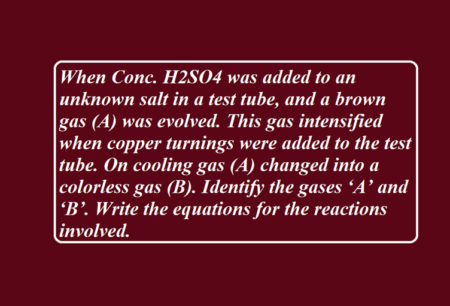
    When Conc. H2SO4 was added to an unknown salt in a test tube, and a brown gas (A) was evolved. This gas intensified when copper turnings were added to the test tube. On cooling gas (A) changed into a colorless gas (B). Identify the gases ‘A’ and ‘B’. Write the equations for the reactions involved.

    October 19, 2022
    Leave A Reply Cancel Reply

    READ ALSO

    Haloalkanes And Haloarenes-

    February 9, 2026

    Organic Explanations

    September 8, 2025

    Thermodynamics PDF

    June 3, 2024

    States of Matter Class 11 Notes PDF

    May 30, 2024
    +2

    Haloalkanes And Haloarenes-

    By Dr. Vikas JasrotiaFebruary 9, 2026

    Haloalkanes And Haloarenes Read the given passage and answer the questions below: Passage – 1:…

    +2

    Organic Explanations

    By Dr. Vikas JasrotiaSeptember 8, 2025

    Organic Chemistry Important Explanations Organic Explanations S.No 1 Bond enthalpy decreases as: CH3-F > CH3-Cl…

    Class 11

    Thermodynamics PDF

    By Dr. Vikas JasrotiaJune 3, 2024

    THERMODYNAMICS PDF THERMODYNAMICS PDF Introduction Chemical thermodynamics deals with the relationship between various forms of…

    Advertisement
    Advertisement
    Facebook X (Twitter) Instagram Pinterest YouTube
    • Disclaimer
    • Contact Us
    • Privacy Policy 
    • Terms and Conditions
    © 2026 All Rights Reserved ScienceMotive.

    Type above and press Enter to search. Press Esc to cancel.