Close Menu
    Facebook X (Twitter) Instagram
    ScienceMotive
    • Class 9
      • Matter in Our Surroundings
      • Is Matter Around Us Pure
      • Atoms and Molecules
      • Structure of the Atom
      • The Fundamental Unit of Life
    • Class 10
      • Chapter 1: Chemical Reactions and Equations
      • Chapter 2: Acids, Bases & Salts
      • Chapter 3: Metals & Non-Metals
      • Chapter 4: Carbon and its Compounds
      • Chapter 5: Periodic Classification of Elements
      • Chapter 6: Life Processes
      • Chapter 7: Control and Coordination
      • Chapter 8: How Do Organisms Reproduce?
      • Chapter 9: Heredity and Evolution
      • Chapter 10: Light – Reflection and Refraction
      • Chapter 11: Human Eye and the Colourful World
      • Chapter 12: Electricity
      • Chapter 13: Magnetic Effects of Electric Current
      • Chapter 14: Sources of Energy
      • Chapter 15: Our Environment
      • Chapter 16: Management of Natural Resources
    • Class 11
      • Chemisrty 11
        • Chapter – 1 Some Basic Concepts of Chemistry
        • Chapter – 2 Structure Of Atom
        • Chapter – 3 Classification of Elements and Periodicity in Properties
        • Chapter – 4 Chemical Bonding and Molecular Structure
        • Chapter – 5 States of Matter
        • Chapter – 6 Thermodynamics
        • Chapter – 7 Equilibrium
        • Chapter – 8 Redox Reaction
        • Chapter – 10 s-Block Elements
        • Chapter – 13 Hydrocarbons
    • Class 12
      • Chemistry 12
        • The Solid State
        • Solutions
        • Electrochemistry
        • Chemical Kinetics
        • Surface Chemistry
        • p – Block Elements
        • d & f Block Elements
        • Coordination Compounds
        • Haloalkanes and Haloarenes
        • Alcohols, Phenols and Ethers
        • Aldehydes, Ketones and Carboxylic Acids
        • Amines
        • Biomolecules
        • Polymers
        • Chemistry in Everyday Life
    • Practice Questions
      • +1
      • +2
    • Test Series
      • Class 9 Test Series
      • Class 10 Test Series
      • Class 11 Test Series
      • Class 12 Test Series
    • World
      • Current Affairs
      • General Knowledge
    ScienceMotive
    Home » Solutions Chemistry Class 12 MCQ

    Solutions Chemistry Class 12 MCQ

    Dr. Vikas JasrotiaBy Dr. Vikas JasrotiaAugust 2, 2021No Comments
    Share
    Facebook WhatsApp Telegram Twitter Email


    Solutions Chemistry Class 12 MCQ

    Que 1. If sodium sulphate is considered to be completely dissociated into cations and anions in an aqueous solution, the change in freezing point of water(∆Tf ), when 0.01 mol of sodium sulphate is dissolved in 1 kg of water, is (Kf = 1.86 K kg mol-1)
    (A) 0.0372 K                                                              (B) 0.0558 K
    (C) 0.0744 K                                                              (D) 0.0186 K
    Ans 1. (B)
    Reason: Van’t Hoff factor (i) for Na2SO4 = 3
    ΔTf = i Kf m = 3 × 1.86 × 0.01 = 0.0558

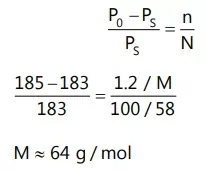
    Que 2. The vapour pressure of acetone at 20°C is 185 torr. When 1.2 g of a non-volatile substance was dissolved in 100 g of acetone a 20°C, its vapour pressure was 183 torr. The molar mass (g mol-1) of the substance is:
    (A) 32                                                                         (B) 64
    (C) 128                                                                       (D) 488
    Ans 2. (B)
    Reason: We know
    Que 3. Acetone and carbon disulphide form binary liquid solution showing positive deviation from Raoult’s law. The normal boiling point (Tb) of pure acetone is less than that of pure CS2. Pick out the incorrect statement among the following
    (A) Boiling temperature of the mixture is always less than the boiling temperature of acetone
    (B) Boiling temperature of Azetropic mixture is always less than the boiling temperature of acetone
    (C) When a small amount of CS2 (less volatile component) is added to an excess of acetone boiling point of the resulting mixture increases
    (D) A mixture of CS2 and CH3 COCH3 can be completely separated by simple fractional distillation
    Ans 3. (D)
    Reason: A mixture of CS2 and CH3 COCH3 can be completely separated by simple fractional distillation.

    Solutions Chemistry Class 12 MCQ

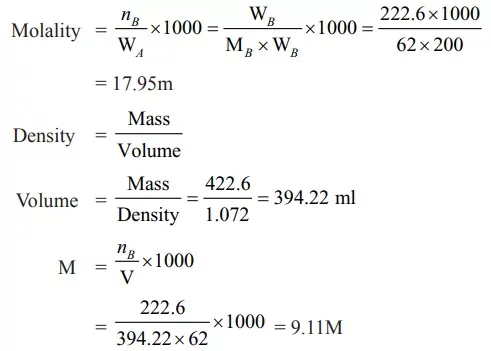
    Que 4. An antifreeze solution is prepared from 222.6 g of ethylene glycol C2H4(OH)2 and 200 g of water. Calculate the molality of the solution. If the density of this solution be 1.072 g mL-1, what will be the molarity of the solution?
    (a) 7.20 M                               (b) 12.03 M
    (c) 9.11 M                               (d) 6 M
    Ans 4. (c)
    Reason: MB of C2H4(OH)2 = 62 g/mol
    Que 5. Which of the following solutions have the highest boiling point and why?
    (a) 1M glucose                (b) 1M KCl                (c) 1M aluminium nitrate
    Ans 5. (c)
    Reason: 1 m glucose
    Value of i = 1  (for non-electrolytes)
    So, molal concentration will be = 1 × 1 = 1m
    1 m KCl
    Value of i = 2
    So, molal concentration will be = 1 × 2 = 2m
    1 m Al(NO3)3
    Value of i = 4
    So, molal concentration will be = 1 × 4 = 4m

    Que 6. Which one of the following statements is false?
    (a) Two sucrose solutions of the same molality prepared in different solvents will have the same freezing point depression
    (b) The osmotic pressure (π) of a solution is given by the equation π = MRT, where M is the molarity of the solution
    (c) Raoult’s law states that the vapour pressure of a component over a solution is proportional to its mole fraction
    (d) The correct order of osmotic pressure for 0.01 M aqueous solution of each compound is BaCl2 > KCl > CH3COOH > Sucrose
    Ans 6. (a)
    Reason: Two sucrose solutions of the same molality prepared in different solvents will have the same freezing point depression.

    Solutions Chemistry Class 12 MCQ

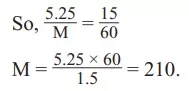
    Que 7. A 5.25% solution of a substance is isotonic with a 1.5% solution of urea (molar mass = 60 g mol–1) in the same solvent. If the densities of both the solutions are assumed to be equal to 1.0 g cm–3, the molar mass of the substance will be:
    (a) 115.0 g mol–1                                            (b) 105.0 g mol–1
    (c) 210.0 g mol–1                                            (d) 90.0 g mol–1
    Ans 7. (c)
    Reason: Solutions with the same osmotic pressure are called isotonic. Let the molar mass of the substance be M
    π1 = π2 C1 RT = C2 RT
    So, C1 = C2 As density of the solutions are the same
    Que 8. When mercuric iodide is added to the aqueous solution of potassium iodide, the:
    (a) Freezing point is raised
    (b) Freezing point does not change
    (c) Freezing point is lowered
    (d) Boiling point does not change
    Ans 8. (a)
    Reason: 2KI + HgI2 → K2[HgI4] ↔ 2K+ + [HgI4]–2 there is a decrease in the number of ions present in the solution so ΔTf decrease or freezing point is raised.

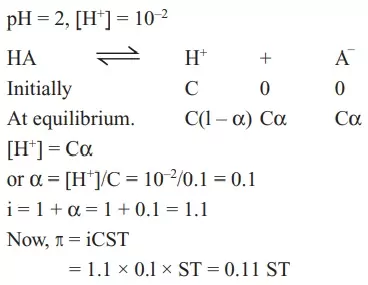
    Que 9. pH of 0.1 M monobasic acid solution is found to be 2. Thus its osmotic pressure at T. Kelvin is:
    (a) 11.11 ST                                       (b) 0.11 ST
    (c) 0.011 ST                                        (d) 1.11 S
    Ans 9. (b)
    Reason:
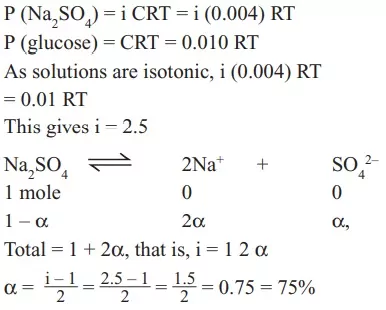
    Que 10. A 0.004 M solution of Na2SO4 is isotonic with a 0.010 M solution of glucose at same temperature. The apparent degree of dissociation of Na2SO4 is:
    (a) 25%                                               (b) 50%
    (c) 75%                                               (d) 85%
    Ans 10. (c)
    Reason:
    Solutions Chemistry Class 12 MCQ

    Advertisement
    Solutions Chemistry Class 12 MCQ
    Share. Facebook Twitter Pinterest LinkedIn Tumblr Email
    Dr. Vikas Jasrotia
    • Website

    Related Posts

    Haloalkanes And Haloarenes-

    February 9, 2026

    Organic Explanations

    September 8, 2025

    CBSE Sample Paper Session 2022-23 (Chemistry) PDF

    September 16, 2022
    Leave A Reply Cancel Reply

    READ ALSO

    Haloalkanes And Haloarenes-

    February 9, 2026

    Organic Explanations

    September 8, 2025

    Thermodynamics PDF

    June 3, 2024

    States of Matter Class 11 Notes PDF

    May 30, 2024
    +2

    Haloalkanes And Haloarenes-

    By Dr. Vikas JasrotiaFebruary 9, 2026

    Haloalkanes And Haloarenes Read the given passage and answer the questions below: Passage – 1:…

    +2

    Organic Explanations

    By Dr. Vikas JasrotiaSeptember 8, 2025

    Organic Chemistry Important Explanations Organic Explanations S.No 1 Bond enthalpy decreases as: CH3-F > CH3-Cl…

    Class 11

    Thermodynamics PDF

    By Dr. Vikas JasrotiaJune 3, 2024

    THERMODYNAMICS PDF THERMODYNAMICS PDF Introduction Chemical thermodynamics deals with the relationship between various forms of…

    Advertisement
    Advertisement
    Facebook X (Twitter) Instagram Pinterest YouTube
    • Disclaimer
    • Contact Us
    • Privacy Policy 
    • Terms and Conditions
    © 2026 All Rights Reserved ScienceMotive.

    Type above and press Enter to search. Press Esc to cancel.