Author: Dr. Vikas Jasrotia

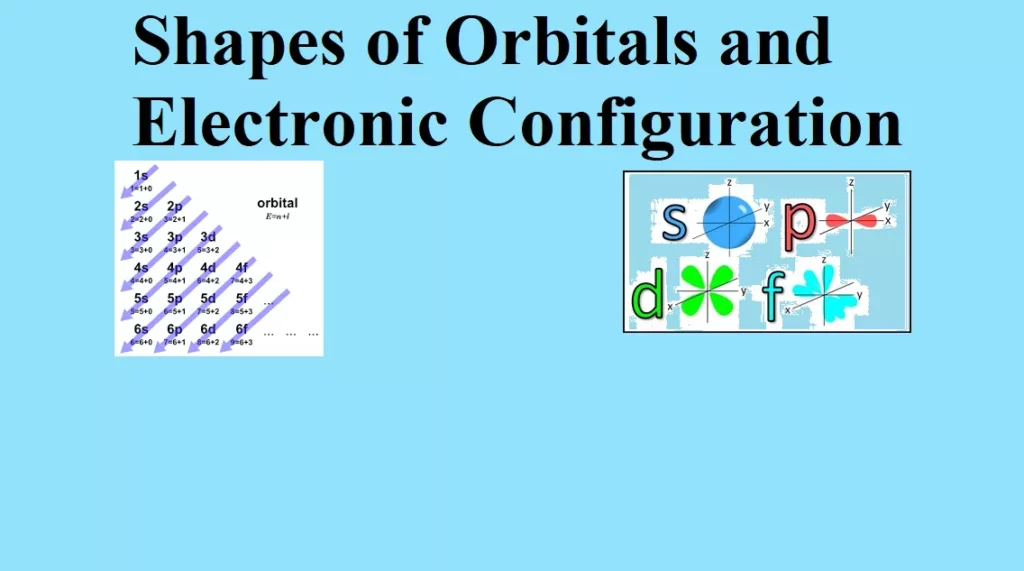
Shapes of Orbitals and Electronic Configuration Shapes of Orbitals: (i) s-orbitals: For s-orbitals, Ɩ = 0 and hence m = 0. So, there is only one possible orientation for s-orbitals. They are spherically symmetrical. The plots of probability density (ψ2) against distance from the nucleus (r) for 1s and 2s atomic orbitals are as follows: For 1s orbital, the probability density is maximum at the nucleus and it decreases with an increase in r. But for 2s orbital, the probability density first decreases sharply to zero and again starts increasing. After reaching a small maximum it decreases again and approaches zero as…

Read More

p-Block Elements Class 12 Important Questions Que 1. Sulphur has more tendency to show catenation than oxygen. Explain. Ans 1. Due to the stronger S‐S bond and due to small size and greater inter electronic repulsion O‐O bond is weakened so it can’t show catenation. Que 2. Why nitric oxide becomes brown when released into the air? Ans 2.  Nitric oxide becomes brown when released into the air due to the formation of Nitrogen Dioxide (NO2) 2 NO + O2 → 2 NO2 Colourless         Brown Que 3. Explain why SF4 is easily hydrolysed, whereas SF6 is resistant to hydrolysis? Ans…

Read More

p-Block Elements Class 12 Notes p-Block Elements Class 12 Notes The elements in which the last electron enters in the valence p-subshell are called the p-block elements. They include elements from groups 13 to 18. Their general electronic configuration is ns2np1-6 where n = 2 (except He which has 1s2 configuration). They, includes metals, non-metals and metalloids. Elements belonging to the s and p-blocks in the periodic table are called the representative elements or main group elements. Inert pair effect:  The tendency of ns2 electron pair to participate in a bond formation decreases with the increase in atomic size. Within…

Read More

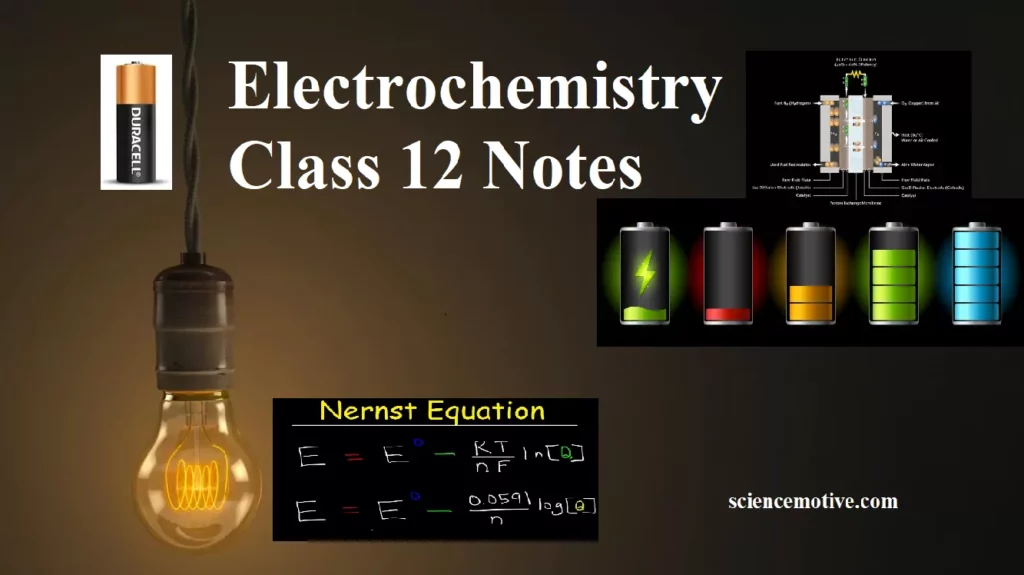
Electrochemistry Class 12 Notes Syllabus:- Electrolytic cells & Galvanic cells The function of Salt Bridge Redox reaction, EMF of the cell, standard electrode potential Standard hydrogen electrode (SHE) Nernst equation and its application to Chemical cell Equilibrium Constant from Nernst Equation Electrochemical Cell and Gibbs Energy Electrochemistry: It is a branch of chemistry that deals with the relationship between chemical energy and electrical energy and their interconversions. Redox Reactions: Oxidation is the process that involves the loss of electrons & reduction is a process in which it involves the gain of electrons. The reactions which involve both that reaction…

Read More

Surface Chemistry Notes Class 12 Surface Chemistry is the branch of chemistry that deals with the study of the phenomenon occurring at the surface than bulk. Adsorption: The accumulation of molecular species at the surface rather than in the bulk of a solid or liquid is termed as adsorption. Adsorbate: The substance which is adsorbed is called adsorbate. Adsorbent: The substance whose surface on which adsorption takes place is called adsorbent. The commonly used adsorbents are charcoal, silica gel, alumina gel, clay, colloids, metals in a finely divided state, etc. Adsorption is a surface phenomenon. Some examples of adsorption are:…

Read More

Multiple Choice Questions Chemical Kinetics Que 1. In the reaction 2 NO + Cl2 → 2 NOCl, it has been found that doubling the concentration of both the reactants increases the rate by a factor of eight but doubling the chlorine concentration alone only doubles that rate. Which of the following statement is correct? 1. The reaction is second order in Cl2 2. The reaction is first order in NO 3. The overall order of the reaction is 2 4. The overall order of the reaction is 3 Ans 1. The overall order of the reaction is 2. Que 2. The…

Read More

Chemical Kinetics Class 12 Important Questions Que 1. Define the following: (a) Rate of reaction (b) Specific reaction rate or rate constant. Ans 1. (a) The change in concentration of any reactant or product per unit time is called the rate of reaction. (b) It is equal to the rate of reaction when the molecular concentration of reactant is at unity. Que 2. The rate law for a reaction is Rate = K [A] [B]5/2. Can the reaction be an elementary process? Explain Ans 2. No, because an elementary reaction is a chemical reaction in which one or more chemical species react directly to form products…

Read More

Chemical Kinetics Questions with Answers Chemical Kinetics Que 1. The rate constant of a reaction is 0.005 molL–1s–1. What is the order of this reaction? Ans 1. Zero-order reaction. Que 2. In a reaction, 2A → Products, the concentration of A decreases from 0.5 mol L–1 to 0.4 mol L–1 in 10 minutes. Calculate the rate during this interval? Ans 2: Rate = – change in conc. of A/2 × time interval = – [0.4 ‐ 0.5]/2 × 10 = 0.005 mol L–1min–1 Que 3. The rate constant for a first-order reaction is 60 s–1. How much time will it take to reduce the initial…

Read More

Collision Theory and Arrhenius Equation Arrhenius equation: Quantitatively, the temperature dependence of the rate of a chemical reaction can be explained by Arrhenius equation k = A e – Ea /RT where A is the Arrhenius factor or the frequency factor or the pre-exponential factor. R is gas constant and E a is activation energy measured in joules/mole. The factor e – Ea /RT corresponds to the fraction of molecules that have kinetic energy greater than Ea. Thus, it has been found from the Arrhenius equation that increasing the temperature or decreasing the activation energy will result in an increase in the rate…

Read More

Half-Life of A Reaction The half-life of a reaction (t1/2): It is the time in which the concentration of a reactant is reduced to one-half of its initial concentration. It is represented by t1/2. (i) Half-Life of a Zero Order Reaction: For a zero-order reaction, the integrated rate law is: k = [R0] – [R]               t When t = t1/2, [R] = ½ [R0] On substituting these values in the above equation, k = [R0] – ½ [R0]                t1/2 t1/2 = [R0]           2k …

Read More